Bell, Emily Hones
Place of Birth: London
Date of enlistment: 12 March 1872 (Marriage)
Age given at enlistment: 21
Rank: Wife of Lt James M. Bell
Company: D
Location on 25 June 1876: On furlough
"A Woman of more than ordinary beauty”
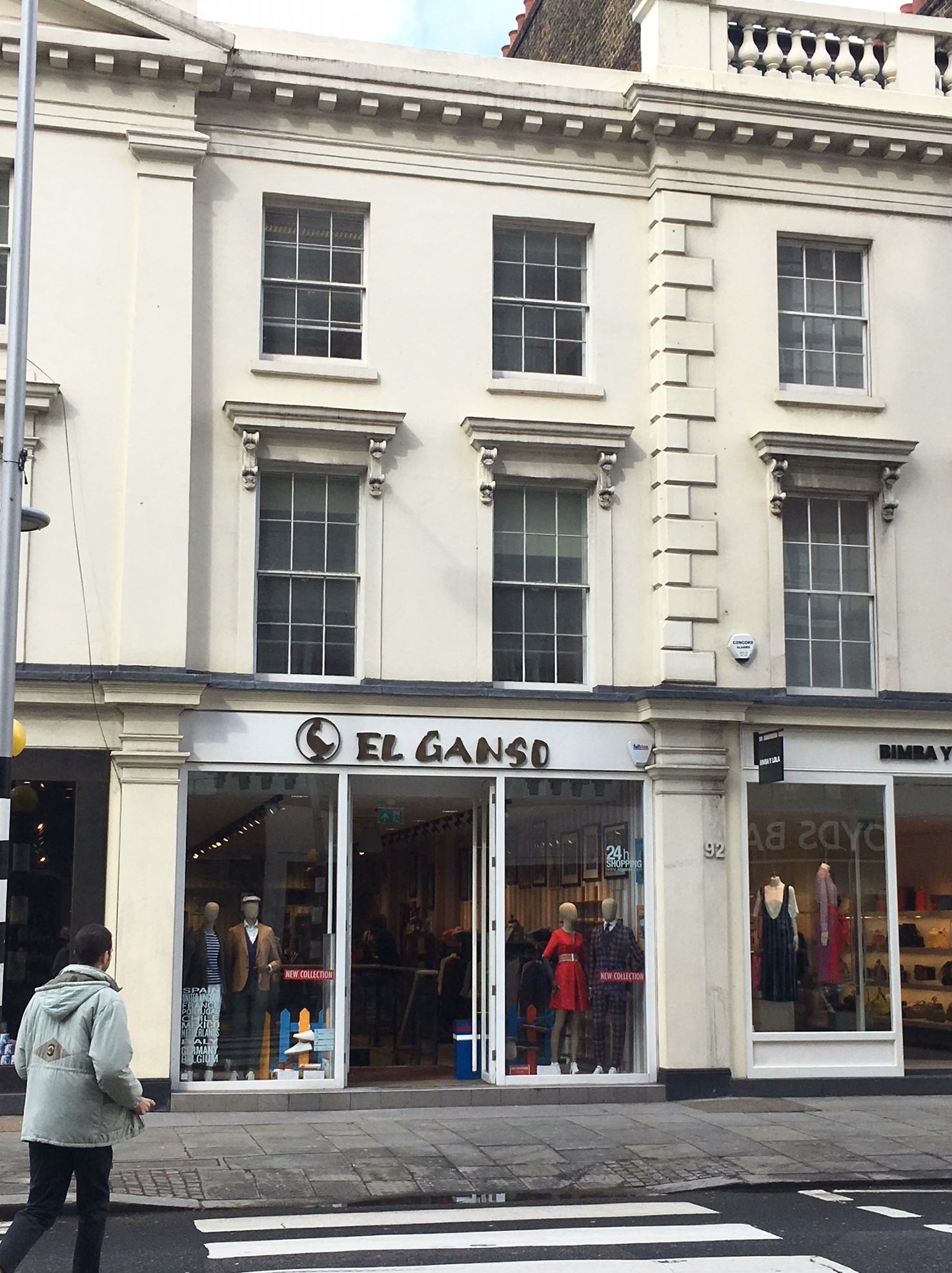
94 King's Road (formerly 11 Colvill Terrace), Chelsea. Emily Mary Hones was born here. (Author's photograph, 12 March 2018.)
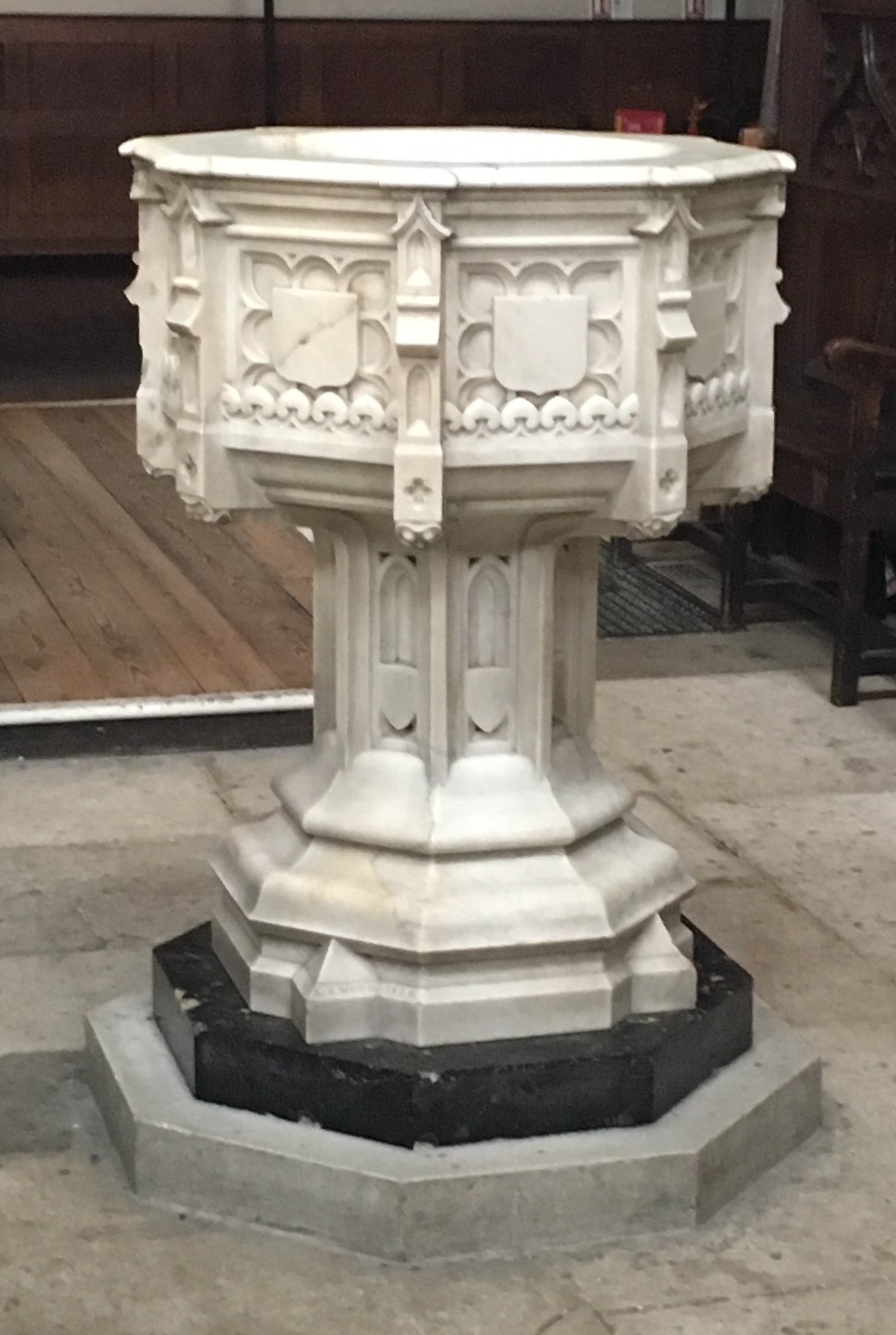
Emily Mary Hones was baptised at this font (dates from 1826), in St Luke's Church, Chelsea. (Author's photograph, 12 March 2018.)
- Emily Hones Bell guaranteed her place in American military history as the victim of ‘inappropriate behaviour’ by a predatory post commander at Fort Abercrombie, Dakota Territory, in December 1876. Found guilty on seven of the eight charges filed against him, the much-maligned major was sentenced to be dismissed from the Army though, shortly after, this seemingly harsh sentence was reduced to suspension from rank and pay for two years with effect from 1 May 1877.
- This writer is neither qualified nor inclined to pass moral judgement of his fellow countrywoman but is prepared to accept that there may have been times when this slender, dark-haired 25-year-old, described by the contemporary press as “of more than ordinary beauty and … of a vivacious disposition,” acted in an extrovert and over familiar manner. It should be borne in mind that this event took place in the last quarter of the nineteenth century when rigid Victorian values were far different from those we enjoy today.
- Emily Mary Hones, the fourth and youngest child of Thomas Maskell Hones, a fishmonger, and Sarah Ball Hones, was born at 11 Colvill Terrace, on the fashionable King’s Road, Chelsea, London, England on 12 March 1851. Together with her older sister, Sarah Frances, Emily was baptised by the Rev. Richard Lediard, at the parish church of St Luke, on 27 March 1853.
- In 1851, Thomas Hones had filed for bankruptcy and at some unknown date decided to seek a better life for his family in America. It must be assumed that he travelled ahead of his wife, four children and sister-in-law, Emma Ball, who arrived in New York from London on 1 June 1857 aboard the sailing ship Mary Bradford.
- The family most likely remained in New York until Thomas found work as a brewer in Portsmouth, New Hampshire. The Honeses lived at 61 Islington Street and this strongly suggests that he was employed at the famous Frank Jones Brewery which, in 1858, had moved into the city to start producing ale.
- Sarah Ball Hones succumbed to ‘dropsy’, an old name for edema, on 14 December 1860 and was buried in Harmony Grove Cemetery, Portsmouth. However, her bereaved husband’s grief appears to have been short-lived as he lost no time in ‘tying the knot’ with the family’s young, live-in servant, Mary Kennedy from Scotland, who before the following year was out had presented him with a third son whom they called William.
- Inland Revenue Service Tax Assessment records for the second half of the 1860s indicate that Thomas Hones, a brewer, was earning $1,100 a year on which he paid tax of $25, i.e., five per cent on all income exceeding $600.
- In 1870, Sarah Frances Hones married Edward Vern Jewell, a captain in the 146th New York Infantry during the Civil War, and the newly-weds set up home in Manhattan, New York, though Emily’s whereabouts during this period remain obscure. We do know that on 12 March 1872, her twenty-first birthday, at the First Trinity Evangelical Lutheran Church, Pittsburgh, Pennsylvania, Emily married First Lieutenant James Montgomery Bell, thirteen years her senior, who was “considered one of the greatest recruiting officers in military history.” A marriage that was to remain childless. Emily’s father died on 17 December the same year and was laid to rest beside her mother in Harmony Grove Cemetery (no headstone).
- Lieutenant Bell, on leave at the time of the Battle of the Little Bighorn and one of the three officers so derisory called “Coffee Coolers” by Captain Frederick W. Benteen, was promoted to the rank of captain with effect from 26 June 1876 to succeed George Yates as commander of Company F.
- The regrettable affair at Fort Abercrombie, referred to above, unfolded over the Christmas Holiday 1876 while Captain Bell was away from the post visiting his sick father in Philadelphia. Major Marcus A. Reno was charged on no less than eight counts, two of which related to his making improper advances to a subordinate officer’s wife. Another said Reno threatened Mrs Bell after she had not invited him, the garrison commander, to a social gathering. Four others recite instances in which the major slandered Mrs Bell to Rev. Richard Wainwright, the chaplain, and others, injurious to her character and, also, accused Reno of falsely quoting fellow officers’ involvement with Mrs Bell. The eighth charge was he gave orders that she should not play the organ at church and sent her a message containing a threat that if she were allowed to play, he would stop the service.
- The prosecution provided damning evidence sustaining each charge, while the defence offered little in the way of evidence and the accused was not even allowed to testify or produce witnesses against Mrs Bell’s character. Almost inevitably, Reno was found guilty and temporarily dismissed from the service.* There were, however, at least some who felt it would have been far better if Mrs Bell had kept her own secrets and borne the insults and smears in silence.
- The fact that Mrs Bell regularly played the organ at garrison church services and was “a general favourite with the officers and their wives” may have been sufficient reason for a resentful Benteen to speak ill of her, much in the same way as his well-documented, disparaging remarks about another beautiful and well-liked army wife forever closely associated with the Seventh Cavalry, namely, Elizabeth Bacon Custer.

Bell's Camp, c.1880. Bell (3rd left). It has been speculated the young woman seated 2nd from the right is his wife, Emilie Hones.
- Captain Bell was brevetted lieutenant colonel for gallantry against the Nez Perce at Canyon Creek, Montana in 1877; participated in the surrender of Chief Gall’s band of Sioux at Poplar Creek, also in Montana, in 1881; served as escort for the construction crews of the Northern Pacific Railroad in the summers of 1880-82; saw action in Cuba and the Philippines in 1899-1901; and retired from the army with the rank of brigadier general in 1901.

Emilie Hones Bell, 1890. (Courtesy Nathan Hulick)

James Montgomery Bell in civilian clothes, 1890. (Courtesy Nathan Hulick)
- The portraits of Emilie and James Bell (above) were taken by Julius C. Strauss at his studio 1245 Franklin Avenue, St Louis, Missouri in 1890.
- Ten years later, the Bells were living in New London, Connecticut while ships’ passenger lists reveal them arriving in San Francisco, California, from Yokohama, Japan, aboard the S.S. Korea on 19 May 1913, and in New York from Rotterdam, Holland, on the S.S. Potsdam on 5 September 1914, just one month and a day after Great Britain declared war on Germany.
- In a letter to Elizabeth Custer from Cookstown, New Jersey, dated 15 December 1918, Brigadier General Edward S. Godfrey [a first lieutenant at Little Bighorn] wrote: “I had a letter from Gen. J.M. Bell, Pasadena, Calif., the other day. He is 81, and in fairly good health. Mrs. Bell was in hospital for operation for bladder troubles, he expects her to be out in several weeks.” It is assumed that the patient made a full recovery as she lived for another twenty-one years!
- James Bell died in Hermosa Beach, California on 17 September 1919 and was interred in San Francisco National Cemetery. Emily, who shared her home with her half-brother, William, a clerk in the Office of the Paymaster-General for over twenty years, returned to Pasadena. William Hones died 23 August 1933 and his mortal remains were taken back to Portland, New Hampshire, to be laid to rest in the family plot in Harmony Grove Cemetery.
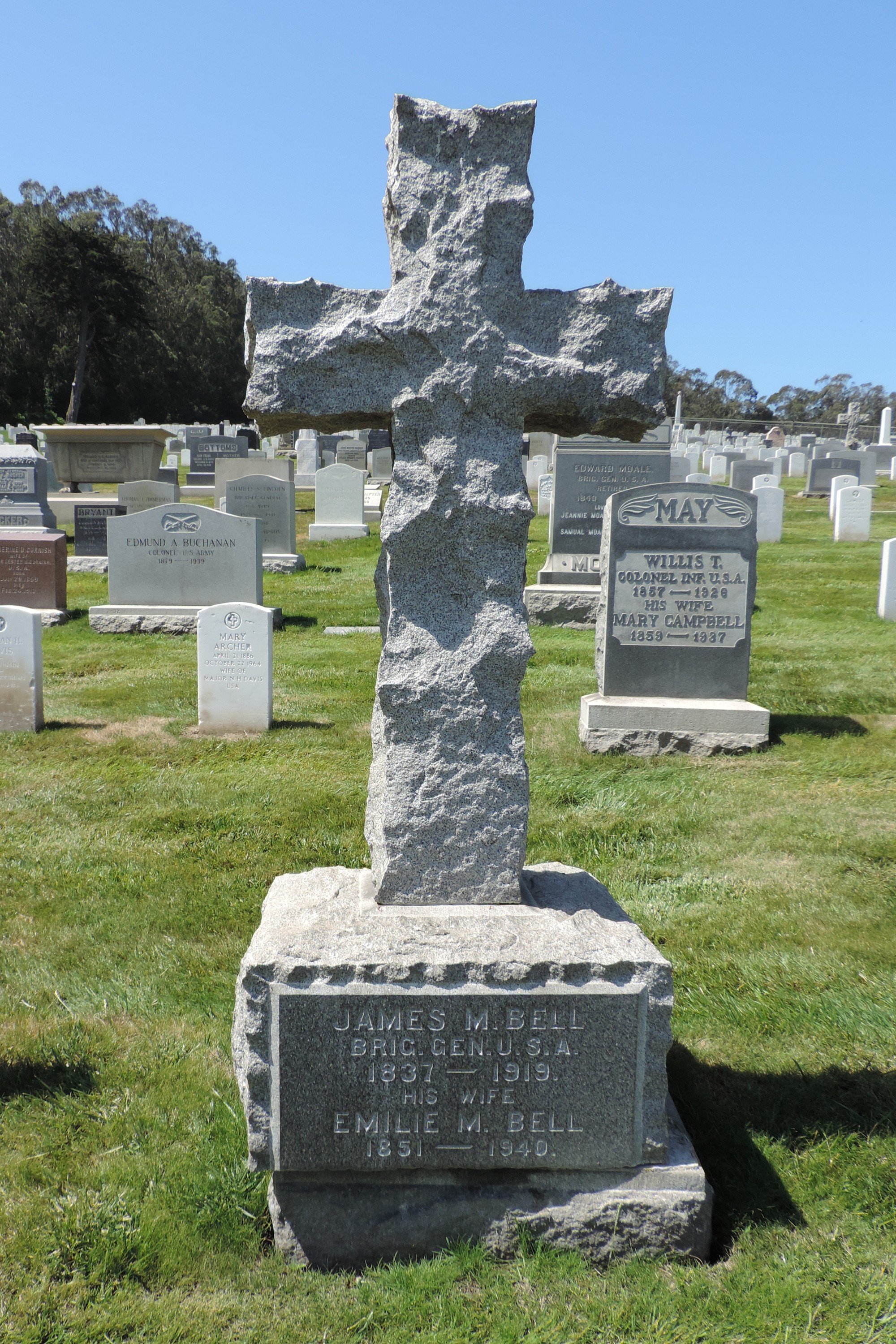
- Emily (also spelled ‘Emilie’) Mary Hones Bell, long since a naturalised American citizen, died at Hermosa Beach, California, on 1 June 1940, from hypo-static pneumonia; she was 89 years old. After cremation, her ashes were placed in her husband’s grave where a fine cross-shaped, granite monument was erected in their memory to mark the spot.
- Note (*): Clearly Reno did not learn his lesson. On 24 November 1879, at Fort Meade, Dakota Territory, he was court-martialled for conduct “unbecoming an officer” and dismissed from the service on 1 May 1880. This was changed to an “honourable discharge” in 1967.
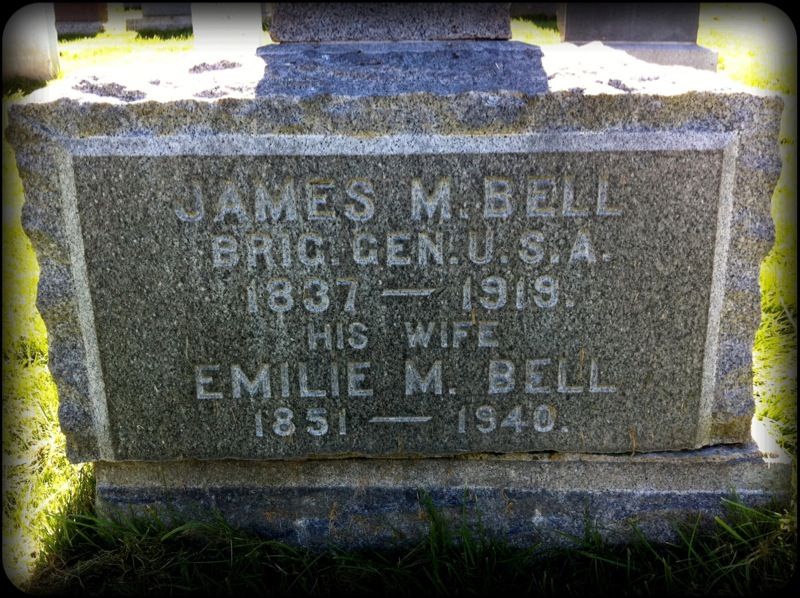
The headstone, left, and inscription, above, erected in memory of James Montgomery Bell and, his wife, Emilie (Emily) Mary Hones Bell, San Francisco National Cemetery, CA.




Comments: