
Little Bighorn Battlefield from Last Stand Hill.
MISCELLANY
- Contact the author/editor at menwithcuster.uk@btinternet.com
- CONTENTS
- 1. Christmas on the Frontier with the Custers (1865)
- 2. Man Killer From Red Cloud
- 3. Sergeant Major William H. Sharrow
- 4. Private James Pym, Company B, engraved revolver
- 5. Custer Bobbleheads
- 6. John Lamplough, Citizen Packer, Quartermaster Dept
- 7. A Case of Stolen Valour? (Patrick J. Ward)
- 8. A Tribute to a General – G. A. Custer
- 9. Ladybird Books – Series 707
- 10. John Laefarr – A Packer who ‘survived’ the Battle of the Little Bighorn
- 11. His mother was charged with the wilful murder of his husband’s wife
- 12. “Straight Through the Heart – A Bullet Carries Corporal Noonan to Eternity”
- 13. Farriers serving with the 7th U.S. Cavalry on 25 June 1876
- 14. How Miles City Acquired Its Name
- 15. William R. Pywell – Official Photographer on the Yellowstone Expedition, 1873
- 16. A Trooper’s March from Fort Shaw to the Little Bighorn
- 17. The John Stuart Stuart Forbes Memorial Plaque, Edinburgh
- 18. The Young Man at the Front – Nelson A. Miles
- 19. Scottsville on the James – General Custer and Major Hill, CSA
- 20. The Fritz Sisters – A surprising connection!
[1] Christmas on the Frontier with the Custers (1865)
- When George Armstrong Custer first went west in 1865, he spent that winter with Libbie in Austin, Texas. “We had a lovely Christmas,” Libbie recalled. “Here we had little opportunity to buy anything, but I managed to get up some trifle for each of our circle. We had a large Christmas tree, and Autie was Santa Claus and handed down the presents, making side-splitting remarks as each person walked up to receive his gift.
- “The tree was well lighted…the rooms were prettily trimmed with evergreens and over one door a great branch of mistletoe, about which the officers sang…Armstrong gave a nice supper, all of his own getting up.” Libbie was positively ebullient, radiating love for the season and her beau. But a decade later, writing to George’s brother, Tom, from New York, she expressed very different thoughts about her husband’s holiday spirit. “Autie always finds the day somewhat of a bore and is glad when it is over.” (Source: The Historynet) The Custers, Texas, 1865 (right).

[2] A Man Killer From Red Cloud

A replica of the pipe tomahawk reputed to be that of Chief Red Cloud, Oglala Lakota (c.1822-1909). He led a successful campaign in 1866–1868 known as "Red Cloud's War" over control of the Powder River Country in northeastern Wyoming and southern Montana.

- The following item was published in the New Orleans Republican, 3 October 1875, and caught my eye.
- “A Man Killer From Red Cloud – Major P. H. Boyle,1 Secretary of Police, exhibited to us on Saturday a tomahawk of most peculiar mechanism, which has somewhat of a history. This Indian instrument of war combines both the weapon and comfort of the great chief, as, attached to the tomahawk, is a pipe of most ingenious and durable make. The handle is made of prepared beech wood, which is cut and molded and then engraved by means of a hot file or rasp. The pith is pushed out of the center, thereby forming a most excellent pipe stem. This peculiar implement was handed to Major Boyle by Sergt. P. H. Rooney, Company H, 7th Cavalry,2 and is said to have been the property of and frequently used by Red Cloud, the celebrated Sioux chief. The major has an idea of sending it to the centennial.” (Also reported in the same newspaper – “The two-foot long instrument is constructed purposely to seek human brains, and it is suggested that it supersede the Bowie knife for social killing.”)
- Notes:
- 1. Major Patrick H. Boyle (1845-1910), served in 1st Louisiana Union Cavalry during the Civil War.
- 2. 1st Sergeant Patrick H. Rooney, born Co. Sligo, Ireland, had been discharged on 14 August 1875 at Fort Randall, Dakota Territory.
[3] Sergeant Major William H. Sharrow
- I am indebted to the talented artist, Tim Bumb, Mandan, North Dakota, for giving me permission to publish his interpretation of an Englishman, Sergeant Major William H. Sharrow, in campaign dress, based on a carte-de-visite courtesy of George Kush, Alberta, Canada. Many thanks to both.
- Two markers are placed north of Last Stand Hill adjacent to the walking trail to the Indian Memorial, one of which may be for Sharrow. Others say that his arrow-riddled body was discovered well over a mile away, beyond the Custer Battlefield Trading Post but north of the river, which begs the question “Was Sharrow carrying a message from Custer to General Terry?” Your comments would be most gratefully received.
- More information on Sharrow, from Sheriff Hutton, near York, can be found on the Biographies page, number 54.
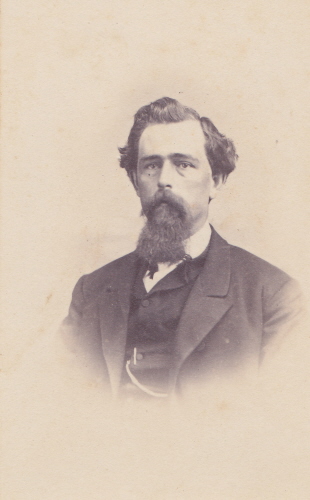
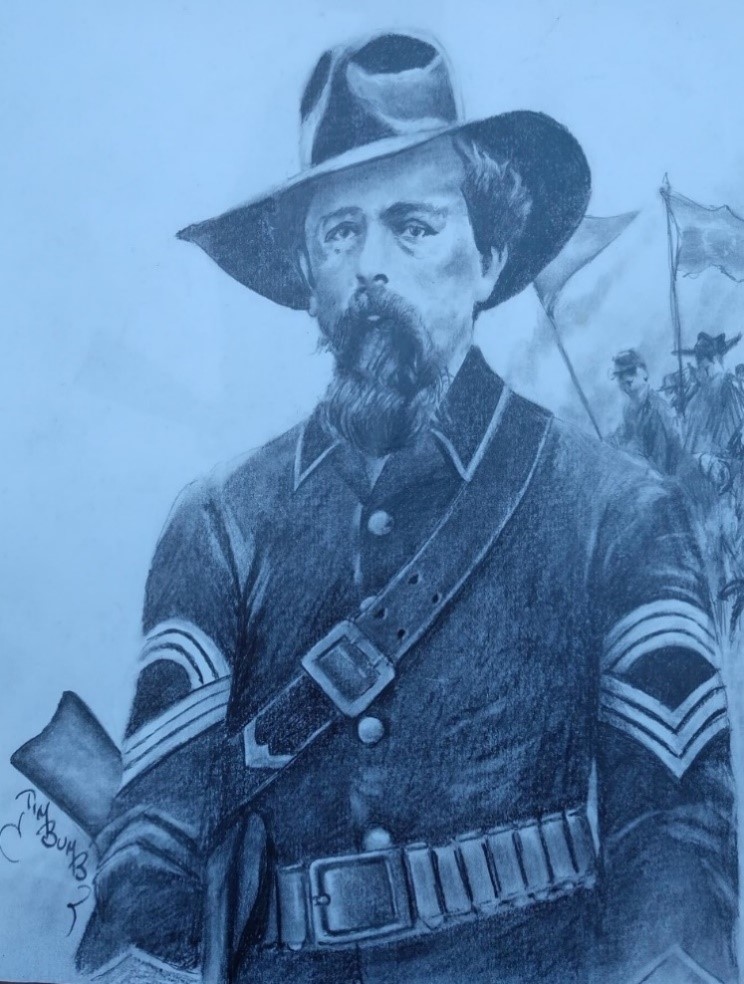
Left - Sergeant Major William H. Sharrow (Courtesy of George Kush) and - Above - (Courtesy of Tim Bumb).
[3] Private James Pym, Company B, engraved revolver
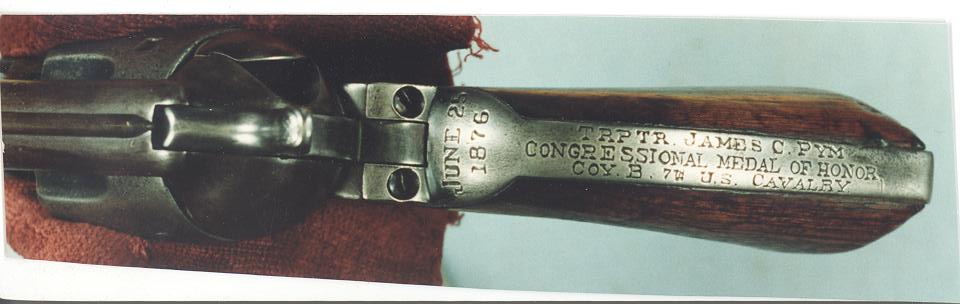
Colt .45 SAA engraved with the name of James Pym Coy B. 7th U.S. Cavalry - (Photograph courtesy of David Trevallion)
[4] Custer Bobbleheads
- The gripping film, The Ice Road, starring Liam Neeson, featured Amber Midthunder as Tantoo, a young Indigenous truck driver, navigating the treacherous ice roads of northern Canada. Ironically relying on a dashboard bobblehead model of General Custer for safety, Tantoo explains to her passenger the delicate balance required to avoid disaster on the ice. “See Custer’s head there? Tips us off to pressure waves. You go too fast you create pressure waves, in you go. You go too slow, the ice can’t handle the pounds per square inch on your tyres, in you go.” Tension rises near the end of the film when Tantoo’s driver less truck plunges into a deep ravine, resulting in Bobblehead Custer’s demise!


- Custer and the Second Battle of Hagerstown
- Shortly after Lee’s defeat at Gettysburg, the Union army was determined to secure its northern flank and the mission to capture Hagerstown, Maryland, was assigned to newly appointed Brigadier General George Armstrong Custer and his Michigan Cavalry Brigade. On Sunday morning, 12 July 1863, Custer’s Wolverines rode into town from the east, scattering and capturing stunned Confederates, seizing almost a hundred prisoners, and setting free nearly forty Federal soldiers, missing after the fighting of six days earlier. Local citizens sympathetic to the Union cause had been sheltering these men. A victorious Custer led his Michigan Cavalry through Hagerstown doffing his hat to handkerchief-waving ladies. At one point, he was watching Confederate troop movements from the bell tower of what is now the Zion Reformed United Church of Christ narrowly avoiding being shot by a Southern sharpshooter. How close history came to be rewritten!
- Captain James Kidd, Custer’s Michigan Cavalry, wrote -“Hagerstown was a hornet’s nest of sharpshooters armed with telescopic rifles, who could pick a man’s ear off half a mile away. The bullets from their guns had a peculiar sound, something like the buzz of a bumble bee, and the troopers’ horses would stop, prick up their ears and gaze in the direction whence the hum of those invisible messengers could be heard.”
- Louise Kealhofer, a young Confederate sympathiser, confided to her diary – “Sunday (12 July) was a day of intense anxiety. The Yankees came and took possession of the town. The Rebels had all gone. Yesterday all the streets were crowded with horse and no one could go near the door as the street was used as a stable. … It is reported that the Rebels have crossed the river but we know nothing. Oh, this dreadful suspense. …I fear we’ve seen the very last of the Rebels.”
- One thousand models of an earlier version of a Custer bobblehead (above) were given away on a first-come, first-served basis at the Hagerstown Suns baseball game on 29 June 2013 to commemorate the 150th anniversary of GAC’s promotion to the rank of brigadier general of volunteers – one of which is a valued item in my collection of Custer memorabilia.
[6] John Lamplough, Citizen Packer, Quartermaster Dept
- Little appears to be known with any certainty about John Lamplough beyond his short service as a citizen packer with the Quarter Master Department during the Little Big Horn campaign and the painful few months that preceded his death on 8 February 1881.
- However, it is not unreasonable to assume that he was the ‘J. Lamplough, 35, male, English‘ who arrived in New York, from Liverpool via Queenstown, Ireland, on 16 June 1866 aboard the recently launched. 2,556-ton Inman Line steamship, City of Paris. Equally, by the process of elimination, he was almost certainly the 40 year-old Englishman recorded as a ‘Common Laborer’ staying in a hotel run by New Yorkers S. L. and Maggie Winters at Sauk Centre, Stearns County, Minnesota; but at the time of writing a conclusive link has yet to be made.
- We do know that he lived in Bismarck for a time before being hired at Fort Lincoln, on 16 May 1876, by Lt. Henry Nowlan, 7th Cavalry, Acting Assistant Quartermaster, “to pack supplies on public animals” for $50 a month and that his duties also included driving a wagon as far as the Powder River Depot. It is most unlikely however that he was present at the Battle of the Little Big Horn.
- Lamplough was honourably discharged on 23 September 1876 when he was due $138.33, being his pay from the first of July. Again he resided in Bismarck for a while but around the turn of the New Year, or before, it seems he had left for a destination unknown as, on 20 January 1877, a single item of mail remained uncollected at the Post Office there. One would be most interested to know the identity of the correspondent.
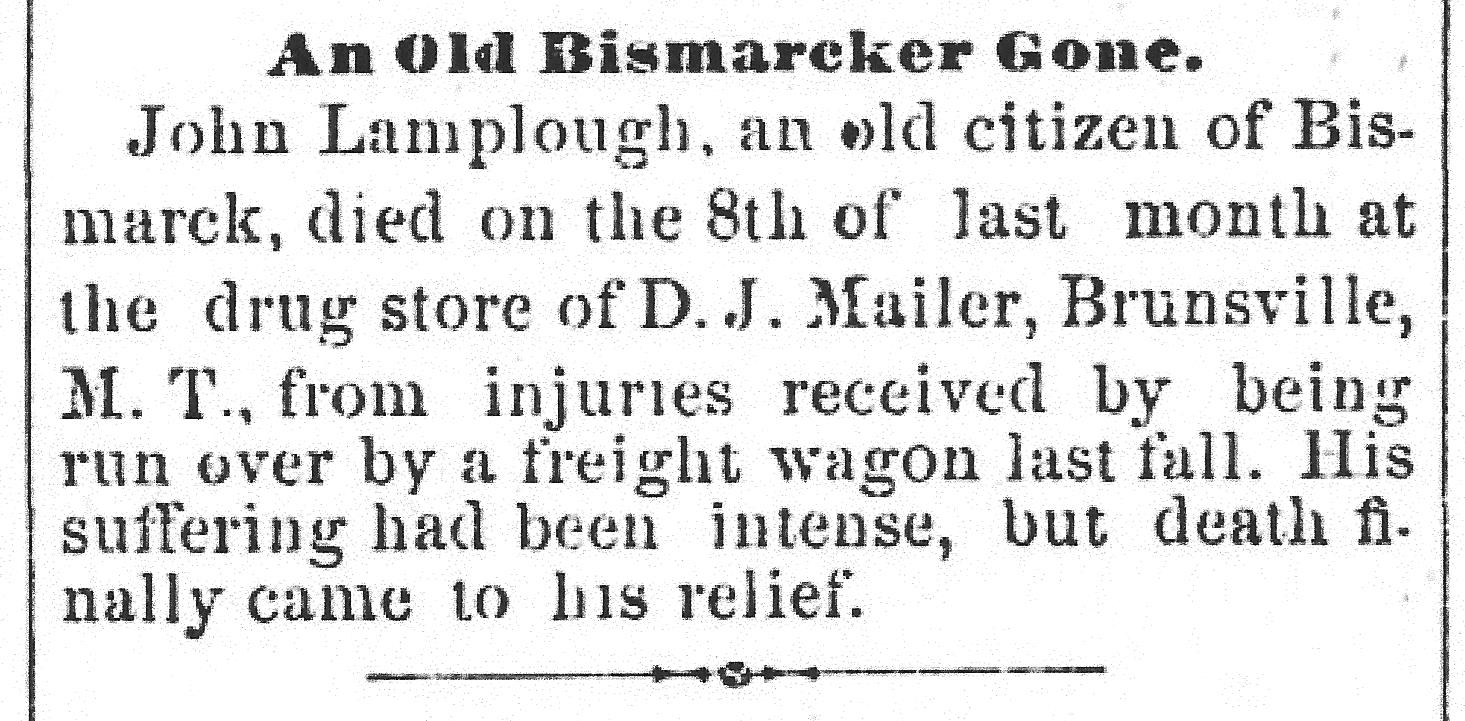
- A report in The Bismarck Tribune, 18 March 1881, reads – An Old Bismarcker Gone – John Lamplough, an old citizen of Bismarck, died on the 8th of last month at the drug store of D. J. Mailer, Brunsville, M.T. from injuries sustained by being run over by a freight wagon last fall. His suffering had been intense, but death finally came to his relief.
- Was dying at a drug store merely a coincidence? Or, was it the result of taking an overdose of laudanum, either by default or design, to relieve the unbearable pain? Two questions that are unlikely ever to be answered.
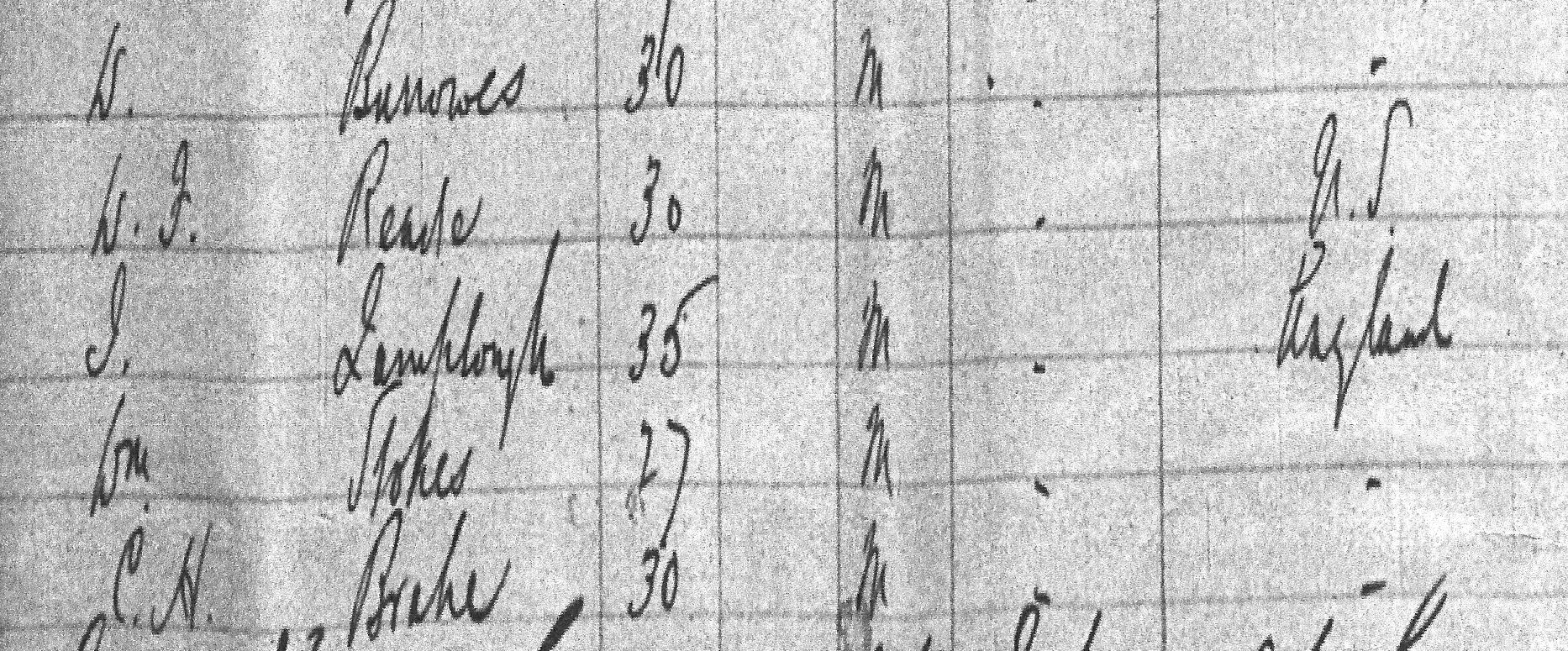
New York, Passenger Lists, 1820-1891. SS City of Paris. Ref: 267 8 Jun 1866 - 23 Jun 1866, image 406 out of 599.
The Bismarck Tribune, 18 March 1881
- At the time of Lamplough’s death, Brunsville was a thriving, but purely temporary, settlement at Cedar Creek on the Yellowstone River, with twelve saloons, a general merchandise store and a drugstore owned by Dr Mailer of St Paul. It existed solely to serve the workforce doing the grading for the Northern Pacific Railroad extension. When they moved on, so did the shops and saloons and the ‘town’ was abandoned. Presumably John Lamplough’s mortal remains lie in an unmarked grave where Brunsville once stood.
- In the mid-19th century the largest concentration of those bearing the surname Lamplough (or Lamplugh) was in the East Riding of Yorkshire but the place, and the exact year of birth of this citizen packer, remain unknown to this writer.
[7] A Case of Stolen Valour? ( Patrick J. Ward)

- If the inscription on the headstone (left) in Grand Junction Cemetery, Tennessee, is to be believed then the identity of this trooper should be easy to trace. A meticulous search of U.S. Army records, however, failed to find anyone matching his description. So, who was Patrick J. Ward? Had he enlisted under a different name? Was he a deserter and the surname “Ward” is itself an alias? Or did his wife genuinely believe her deceased husband had served with Custer, hence the wording on the headstone was chosen in good faith? Four questions that are unlikely ever to be satisfactorily answered.
- We do know that Patrick Ward, from Dublin, Ireland, married Mary A. “Mollie” Moore, daughter of James P. Moore, from England, at the Catholic Church in Grand Junction on 17 May 1881. They were to have six children. On 16 July 1889 Ward, styled as ‘merchant’, was appointed postmaster at Grand Junction, but then the trail goes cold until his death in the same city on 9 February 1911. Mary, who never made a claim for an Indian Wars’ widow’s pension, died on 31 October 1943 and lies buried in the same cemetery (no headstone).
[8] A Tribute to a General - G.A. Custer

Number 12 of a limited edition of 150 replica gold badges by Frank L. Mercatante. (Editor’s collection)
- The name on the central arms of the Maltese cross clearly identifies the intended honouree, as does the brigadier’s star, which surmounts the cross. “Tuebor,” [I will defend] the legend from the state flag and seal of Michigan, implies who its defenders will be, the Michigan Brigade, the branch of service, is evidenced by the crossed sabres and the brilliant yellow ribbon.
- Frank Mercatante, noted expert of Custeriana, offered the beautiful reproduction of this badge in either gold or silver as both are represented in the three surviving badges. Unfortunately, the fate of the badges worn by George and Elizabeth Custer is unknown.
- In the centre of the brigadier’s star of the surviving badges a number appears, a “6,” a “7,” and a “25,” representing the Michigan brigade. The “6” and “7” need no explanation. The “25,” however, designates the New York cavalry, which was added to the Brigade for the Battle of Winchester. Therefore, the Custer Badge is not a medal of valour, but a badge of pride that accrued to members of the Michigan brigade. Colonel James H. Kidd, 6th Michigan Cavalry, gave clear testimony of his feelings on the day he received the Custer badge from his fellow officers, 1 January 1865.*
- Why have so few badges survived? Consider the following: (1) Cost. At a reputed $27 per gold badge, a soldier would have to set aside two months’ pay to buy one. Custer was not a rich man and could not have afforded several years’ pay to purchase badges for his men. (2) Status. The badge was not an official army badge; therefore, the federal government would not have appropriated funds for it. (3) Time. The Custer Badge was created near the end of the Civil War.
- General Custer was proud of his cavalry, his Wolverines, and the badge certainly conveys that affection. Frank Mercatante provided the opportunity for contemporary “Wolverines” to share such pride by the recreation of the Custer Badge.
- (*) Personal Recollections of a Cavalryman with Custer’s Michigan Cavalry Brigade in the Civil War, a personal memoir written by James Harvey Kidd, is considered essential reading by many historians.
[9] Ladybird Books - Series 707

- LADYBIRD BOOKS – SERIES 707 – Published in the UK – 1972 to 1976
- Frank Humphris (1911-1993), an English painter and illustrator, worked as a cartographer in the War Office during WWII. Over many years he amassed a large collection of vintage Western gear and antique guns and became a specialist in Western comics until the early 1970s, when he left to concentrate on painting and writing.
- In 1976, to commemorate the 100th Anniversary of the battle, Humphris published Battle of the Little Big Horn: Custer’s Last Stand. While this series was specifically written for children, I was nonetheless impressed by the accurate account of the events that preceded the 1876 campaign and the portrayal of the battle. The illustrations are of the highest quality. No yellow neckerchiefs or gauntlets in evidence, plus the authentic uniforms and factually correct storyline makes it an excellent primer for this iconic milestone in U.S. history. The above comments apply equally to The Story of the Cowboy (1972) and The Story of the Indians of the Western Plains (1973). Used copies of all three titles are available at very reasonable prices. I am happy to include them in my collection.
- It is said that the late Peter Harrison, author of The Eyes of the Sleepers; Cheyenne Accounts of the Washita Attack (1998) and Monahsetah: The Life of a Custer Captive (2019), gave each new girlfriend a copy of Humphris’ Little Big Horn, so they would better understand his fascination with the Custer story!
[10] John Laefarr - A Packer who 'survived' the Battle of the Little Bighorn
- Here is another survivor of the Battle of the Little Big Horn story, but one that is somewhat different from the usual. It was published in The Hickman Courier, Kentucky, 7 November 1879
- John Laefarr, a tall, fine-looking young Frenchman, with hair perfectly white, which strangely contrasted with someone so young, was pointed out to an Independent reporter last week. He is employed on Charles D. Hard’s(*) ranch, a few miles from town. Although his hair is white he is only twenty-five years old, is compactly built, and stands about six feet high. He left Fort Lincoln in 1875 (sic) as a packer for Custer’s little band, which rode to their death that bright summer’s day on the Little Big Horn. When the fight began the pack train was three miles distant and was attacked by the Indians. The packers were seven in number, and were immediately scattered. Only one escaped John Laefarr. The instant after the attack the horse which he rode was shot dead. Another horse, without saddle or bridle, stood close by, and Laefarr noosed a rope, placed it in the horse’s mouth, jumped upon his back. and started at a full gallop. The firing and yelling were ceaseless. Laefarr had only rode a few yards when he was shot through the neck; a bullet plowed his cheek, and the Indians were fast closing in and heading him off. Another bullet struck him in the thigh. He killed the nearest Indian, but it was no time to linger, for he was headed off on both sides, and a deep, yawning precipice, twenty feet wide, was before him. The desperate boy headed for the chasm, preferring death there to death at the hands of the Indians, urging his horse to his highest speed, he made the fearful leap, and cleared the gap, but the noble horse fell dead a few yards from the precipice, riddled with bullets. John crawled from under him, and as he started to run was shot in the body. Half a mile distant was a belt of timber, whose friendly shelter he was seeking. Barefooted, weak and faint from loss of blood, and the bullets raining after him, the boy kept on with all the speed he could over the prickly pears and sharp-pointed stones. The Indians stopped on the other side of the precipice, and the boy succeeded in making the timber. Here he laid three days without food or water, and very weak from the loss of blood. The fourth morning he got up and attempted to walk, but only walked fifteen or twenty feet when he fell down exhausted. Three Crow Indians saw him as he fell. made signs and started toward him, but he did not know a Crow from a Sioux, and emptied his revolver at them. The Crows finally came up and took him to Reno’s command. Arriving there the boys told him his hair was white, but he did not believe them until a mirror was procured, and he was appalled to find that his hair, which, five days before, was as black as a raven s wing, was now white as snow. He was taken on a steamboat to Fort Lincoln, where he remained five months in the hospital. and, finally recovering, drifted into Montana. Helena (Montana) Independent.
- (*) Charles D. Hard (1847-1927), rancher, horse breeder and prominent local citizen.
- Note:
- Nothing is known about John Laefarr beyond he married Lizzie Ethridge in Lewis and Clark County, Montana Territory, on 3 January 1880. The ceremony was performed by Judge Cornelius Hedges who was a member of the Washburn-Langford-Doane Party in 1870 that explored what we now know as Yellowstone National Park. Hedges is credited as the person who put forward the idea of creating wild areas into national parks.
- On 13 March 1880 a jury in Helena, Montana found Laefarr not guilty of stealing a horse, shortly after which he and Lizzie road off into the sunset!

[11] His mother was charged with the wilful murder of his husband's wife.
- We know that William Henry Illingworth’s* life came to a tragic end, but much less has been written about the events surrounding his early years, which exposed him to criminality, infidelity, and possibly even murder! A report in The Leeds Intelligencer, Saturday, 21 December 1844 provides an insight into a bizarre incident that would have had a traumatic effect on the whole family. It reads:
- “SUSPICIOUS DEATH AT WORTLEY – On Thursday morning week [12 December 1844], Elizabeth Illingworth [née Hutchinson], the wife of William Illingworth, clock-maker, Wortley, near Leeds, died under such circumstances as led to an inquest being held on the body by John Blackburn, Esq., Coroner. A post mortem examination has since been made by Mr. Hall, of Wortley, surgeon, and an analyses of the contents of the deceased’s stomach and intestines has been made by Mr. West, analytical chemist. The result, we understand, leaves no doubt that she died from the effects of poison. In the present state of the investigation, the inquest being adjourned until next week, it would be improper to give currency to the various rumours as to how or by whom the poison was administered.”
- (*) Official photographer on the Black Hills Expedition, 1874.

- A beautifully written e-book (left), entitled The Wortley Watch Maker (2020) by Clare O’Keefe, covers this story.
- The author writes: “What is true, is that much of the following chapters arise as much from the imagination of the writer, as they do from what hard facts can be gleaned from the archives of Yorkshire. But since the story before us requires some substance, and there are a million choices of narrative direction and detail, to fill in the history of the gaps – decisions must be made and the following tale is a web of decisions and particulars – much of it complete supposition. But that at least make a coherence along the journey of points of fact.”
- A well-researched and genuinely fascinating read.
- The coroner’s enquiry resulted in the commital to York Castle, on a charge of wilful murder of Hannah (aka Ann) Simpson (née Silcock), a married woman, kept by the husband of the deceased. She was tried at York on 18 March 1845, acquitted due to lack evidence, and released from the dark prison cell in which she had spent the previous two months. However, only a few weeks after the acquittal, it is said, Hannah was sent to the Wakefield House of Correction for neglecting an unknown number of children, one of whom was her son, William, the illegimate child of William Illingworth, the watchmaker.
- William Illingworth, senior, and Hannah had two further children before emigrating to America in the spring of 1850 when a fourth child, Sarah Alabama (possibly named after the ship on which they sailed) was born at sea on the 18th of May. A half sister of the future photographer, Emma Louise, born 1840, daughter of William Illingworth and Elizabeth Hutchinson, also travelled with them. For a short time, the family settled in Pennsylvania before moving to St Paul, Minnesota, where William set up in business and prospered as a respectable watch and clockmaker. On 13 August 1855, William finally made an ‘honest woman’ of Hannah when they were discreetly married in St Croix, Wisconsin, and eventually would have a total of eleven children.
- Hannah Illingworth died aged 49, on 25 November 1867. William Illingworth, senior, died aged 59, on 23 June 1870. Both are buried in Oakland Cemetery, St Paul, Minnesota, where a joint tablet marks the spot.
- On 3 January 1873, under the heading Personal Intelligence, The New York Herald ran with the following item – “The St. Paul Despatch (sic) reports that £60,000 has been left by Elizabeth Illingworth, of England, to William Illingworth, a St. Paul watchmaker, who recently died without knowing the fortune in store for him in this world or the next.” But this is yet another story waiting to be told.
[12] "Straight Through the Heart - A Bullet Carries Corporal Noonan to Eternity."
- The Bismarck Tribune, 9 December 1878
- Straight Through the Heart – A Bullet Carries Corporal Noonan to Eternity
- “THE SHOT – Corporal Noonan, of the Seventh Cavalry, whose ‘wife’ [a male] died some weeks ago committed suicide in one of the stables of the lower garrison [Fort Abraham Lincoln] Saturday [30 Nov.]. It was reported some days ago that he had deserted, but no one this side of the river had seen him. It now appears that the man had kept himself out of the way as well as he could for several days His comrades had given him a sort of cold shake since the return of the regiment from the chase after the Sioux, and this, and the shame that fell on him in the discovery of his wife’s sex undermined his desire for existence and he crawled away lonely and forsaken and blew out the life that promised him nothing but infamy and disgrace. THE SUICIDE – The suicide was committed with a pistol and Noonan shot himself through the heart. The affair created almost as intense excitement at the post as did the announcement of the death of Mrs. Noonan, but there was a sigh of relief on the corporate lips of the Seventh Cavalry when its members heard that Noonan by his own hand had relieved the regiment of the odium which the man’s presence cast upon them.”

- Corporal John Noonan (or Nunan), Company I, claimed on his third enlistment by Lt George Wallace at Fort Abraham Lincoln on 15 January 1877, that he was age 31, born Fort Wayne, Indiana, and described as having blue eyes, dark hair, a fair complexion and being 5’ 8” tall. He had been on detached service at the Powder River Depot from 15 June 1876 and consequently did not take part in the Battle of the Little Bighorn. Noonan was buried in the post cemetery at Fort Abraham Lincoln and re-interred in the Custer [Battlefield] National Cemetery in 1893, where a headstone (left) marks his grave.
[13] Farriers serving with the 7th U.S. Cavalry on 25 June 1876
- Company A – John Bringes, age c.31, born Hanover, Germany, in valley and hilltop fights, discharged Fort Berthold, Dakota Territory, 22 September, a farrier of excellent character. Place and date of death unknown.
- Company B – James E. “Larry” Moore, age 27, born Hebron, Ohio, with pack train and in hilltop fight, discharged at the camp at the mouth of Rosebud Creek 6 August 1876, a farrier of excellent character. He arrived at Fort A. Lincoln aboard the steamer Durfree four days later. Died of tuberculosis, Union, South Carolina, I November 1894.
- James Moore, a farrier, is described “… as tall and lanky, with a dry sense of humor, a good guy, though not the most literate sort,” in The Ghosts of the Green Grass, J. Lyles “Bud” Alley, 2015, p. 56, Cody Publishing, Signal Mountain, Tennessee, a well-told parallel tale of Custer’s 7th Cavalry in 1876 and the Second Battalion of the same regiment at Ia Drang, Vietnam, in 1965.
- Company C – John Fitzgerald, age c.35. born England (see Biographies, p 16).
- Company D – Vincent Charley, age c.28, born Lucerne, Switzerland, in hilltop fight, killed, having been left behind unmounted, in the retreat from Weir Point, 25 June 1876. Listed as Chas. Vincent on the battle monument and Vincent Charles on his marker on the battlefield.
- Company E – Able B. Spencer, age 31, born Plainville, Wisconsin, with packtrain and in hilltop fight. Reduced to private 1 October 1876, discharged fifteen days later, a private of good character. Died 1 February 1922, Chicago, Illinois, cause unknown.
- Company F – Benjamin Brandon, age c.45, born Hopkinsville, Kentucky, a two-time deserter, killed with Custer’s column, Little Bighorn 25 June 1876 – the oldest casualty in the regiment. Listed as Benj. Brandon on the battle monument.
- Company G – Benjamin J. Wells, age c.33, born Sangamon, Illinois, in valley fight, horse bolted into Indians during retreat, killed Little Bighorn, 25 June 1876. Survived by wife and one child. Listed as Benj Wells on the battle monument
- “Benj. Wells body was found in the river about due north or northwest of where [Lt Donald] McIntosh lay; he lay in the water on his face, with his arms spread out, and no Indians had found him, as his clothes were still on his body.” (Walter Camp’s interview with [Private] James Boyle, 5 February 1913, in Envelope 129, Camp Field Notes, Lilly Library, Indiana University.)
- Company H – John M. Marshall, age 37, born Scarborough (?), Yorkshire, England, in charge of company property and garden at Fort Rice, D.T. Captain Frederick W. Benteen, commanding Company H, was also concerned that his mare and colts received good care in his absence. Marshall reenlisted at Fort Rice 3 January 1878 and deserted from Fort A. Lincoln 19 May 1879. His fate is unknown.
- Company I – John Rivers, age c.32, born Westchester, New York, at Powder River Depot.
- “John Rivers of Company I will conscientiously observe that he [Captain Myles Keogh’s horse, Comanche] is never required to endure an more work. His stall will be the cleanest and warmest at the fort, and his forage the best the army affords. (Bismarck Tribune, 10 May 1878) In the Nez Perce Campaign, Rivers was wounded at the battle of Bears Paw Mountain, 30 September 1877. Discharged at Fort Totten, D.T., a farrier of excellent character 16 August 1881. His fate is unknown.
- Company K – John R. Steintker, age c.41, born Hanover, Germany, in hilltop fight, died from opium overdose (suicide?), in company quarters, Fort A. Lincoln, 28 November 1876. His remains were re-interred at the Custer National Cemetery, next to Corporal John Noonan, Company I, husband of the infamous “Mrs Nash.” Listed as John R. Steinker on his headstone.
- Company L – William H. Heath, age c.27, born England (see Biographies, p. 25).
- Company M – William M. Wood, age 29, born Grafton, New York, in charge of company property at Fort Rice, D.T. Discharged 11 January 1887 at Fort Rice, a farrier of excellent character. Enlisted in 15th Infantry 12 November 1881, deserted 28 May 1882. Killed accidently, Chicago, Illinois, December 1885.
- SUMMARY
- Country of Origin – USA (6), England (3), Germany (2), Switzerland (1)
- At LBH – USA (4), England (2), Germany (2), Switzerland (1)
- Killed – USA (3), England (1), Switzerland (1)
- Survived – Germany (2), England (1), USA (1)
- Not at LBH – USA (2), England (1)
[14] How Miles City Acquired Its Name
- Private Luther Barker, Company D, 5th U.S. Cavalry, who fought with Nelson Miles in the Battle of Wolf Mountain, 8 January 1877, did not participate in the Nez Perce campaign of the same year. Company D spent much of 1877 constructing a new post at the junction of the Tongue and Yellowstone rivers, initially called Cantonment (Tongue River), later named Fort Keogh after Captain Myles W. Keogh of Company I, 7th U.S. Cavalry when it officially opened on 8 November 1878.

- Half a century later, Barker (left) then National Commander of the Indian War Veterans living in Clay Center, Kansas, tells the story in the Plentywood Herald, 9 September 1927, of how Miles City, Montana, acquired its name. It reads:
- “In the latter part of February 1877, a number of St. Paul citizens, together with several from other eastern cities, arrived at the cantonment and expressed a wish that a townsite be located. About March 1, 1877, Lieutenant Long the Fifth Infantry, myself and another soldier began at the flagstaff in the cantonment and chained three miles down the Yellowstone River. This brought us to a point just above the Buffalo rapids. When the required distance had been chained, we found General Miles, several of his officers and some of the easterners sitting on a cottonwood log that had been washed up on the bank at floodtide. One of the group, noting that we were engaged in locating the eastern boundary line of the reservation and having in mind the establishment of a possible townsite, called out suddenly: “This is Miles City!” The name stuck.”
[15] William R. Pywell - Official Photographer on the Yellowstone Expedition, 1873.

William R. Pywell, c. 1863, by Alexander Gardner.

William R. Pywell driving a wagon carrying his photographic equipment, undated.
- William Redick Pywell, who is credited with taking the earliest known photograph of Pompeys Pillar, was son of Robert Redick Pywell, from the village of Barnwell All Saints, five miles southeast of Oundle, Northamptonshire, where the family had lived for generations. He emigrated to America sometime before 26 September 1840, when he married Ann Maria Diggs in Baltimore, Maryland. William (and his twin, Jane Elizabeth) was born in Baltimore on 9 June 1843. By 1850 the family had moved to Washington, D.C., where his father ran a livery stable.
- Young Pywell trained as a photographer in the studio of Mathew Brady under Scots-born Alexander Gardner. He worked with Gardner and Timothy O’Sullivan, his brother-in-law, in making a photographic record of the American Civil War, which was published in 1866 as Gardner’s Photographic Sketch Book of the War.
- After the cessation of hostilities he opened his own studio in Washington. He wed Margaret Schofield on 9 June 1869; an unhappy, childless marriage that would end with an acrimonious divorce seven years later.

Stereoscopic photograph of Pompeys Pillar, 1873, by William R. Pywell.
- In 1873 Pywell was appointed official photographer for the Yellowstone Expedition led by Colonel David S. Stanley with Lieutenant Colonel George Armstrong Custer, with ten companies of the 7th Cavalry, his second in command.
- William Pywell, then working from 625 D Street, Washington, D.C., placed an advert in The Bismarck Tribune, 15 April 1874, informing its readers the government had withheld the negatives of the Yellowstone Expedition claiming they were its property. After a delay of many months, however, one hundred stereoscopic negatives were temporarily released to Pywell, which enabled him to produce prints on demand. The price per dozen was $3, or the entire set of 100 for $20. A special limited set of 11 x 14 size prints, which included “A superior view of Pompey’s Pillar” (sic) and another entitled “A squadron of Custer’s Cavalry, Capt. Yates commanding” were also on sale. The latter was “Proclaimed a successful picture in every sense of the word. Rarely, if ever, has a large photograph been made where all the horses and riders are so clearly defined as on this occasion.” The cost was $2.50 a copy. At the time of writing, I have not been successful in tracking down a copy of this historic photograph.
[16] A Trooper's March from Fort Shaw to the Little Bighorn


Private Sylvester Waltz, Company B, 7th U.S. Infantry, a member of Colonel John Gibbon’s Montana Column, marched out of Fort Shaw, Montana Territory on 17 March 1876 and arrived at Pompeys Pillar (above) exactly one month later. While on campaign he kept a diary, which was relatively rare for an enlisted man.
- His entry for 18 March 1876 reads: “As we did not move today, went and washed some clothes. Then went to the top of Pompey’s (sic) Pillar. The mass of rock is about 300ft. high and about that in diameter, it being of circular form and at two places the rock resembles a human face. In a large crevice at the top were buried several Crow Indians. Here we found names cut all over the rock of persons who had been here before us. Among them the names of the first explorers of this country, Lewis & Clark, 1806.”
- The entry in his diary relating to the Valley of the Little Horn (sic) for 30 June 1876 is also an interesting one. He writes: “(As I was not there myself was at another part of the battlefield [Reno Hill?], I got this account from a friend of mine which I consider as good as if I were there myself.) He says the Indian village was about six miles long and from one half miles to one and a half miles wide. Dead Indians we found in some tee pees, and in one there was a white renegade sewed up in a blanket. He was a gray headed man with a long beard but was stone dead as the rest in the ravine. Close to the battleground were found dead Indians piled up like cord wood, and it is supposed they carried off a great many more. One chief was found on the field dead. He had broad German silver bands on his arms and was wrapped in a fine buffalo robe.”
- Unfortunately, in this Kindle version edited by Tasha Lebow (2020), Derrick Wolf fails to mention that Waltz served in the 7th Infantry or, indeed, provide any personal details about this trooper. The biographical Afterword runs to barely six lines of text and contains multiple errors of fact, one even confusing Waltz with another bearing the same name, which is most disappointing. Lastly, there are aspects of this edited version of this diary that led me to doubt that it is not as faithful as it might have been, but, that being said, it’s an informative little e-book that I am pleased to add to my collection.
- Who was Private Sylvester Waltz?
- Sylvester Waltz, the eldest son of Elias Waltz, a farmer, and Lucyetta Kintz, was born in Copley Township, Summit County, Ohio, most likely on 28 July 1854, though an unsubstantiated editorial note in his diary claims it to be twelve months later.
- He was orphaned at ten-years-old and the Federal Census (1870) finds him working as a field hand in neighbouring Franklin County. On 7 June 1875, in Cleveland, Ohio, he enlisted in the United States Army, a decision he was soon to regret. He stated he was 21 yrs 6 mths (sic), previously employed as a a farmer, and described as having blue eyes, auburn hair, a fair complexion, standing 5’ 8” tall, later being was assigned to the 7th Infantry, Company B.
- Sylvester and his long-term sweetheart, Tena Catherine Fischer, with whom he had regularly corresponded during the Little Bighorn campaign were married at Fort Snelling, Minnesota, in 1879 after which the bride returned to live with her parents in Norton Township, Summit County, On 7 June 1880 he was discharged at Fort Fred Steele, Wyoming, a private of good character and reunited with his wife in Summit County where she was to bear him five children. The family moved to Toledo where Sylvester worked as a house builder with two of his brothers and later on his own account as a carpenter, before returning to farming. Sylvester Waltz died in Swanton Township, Lucas County, Ohio, on 14 July 1917 lies buried in Woodlawn Cemetery, Toledo. Tena followed her husband to the grave on 29 December 1923.
[17] The John Stuart Stuart Forbes Memorial Plaque, Edinburgh

Plaque erected in the memory of John Stuart Stuart Forbes, St. John's Episcopal Church, Edinburgh. Taken by Sopharana Russell 16 March 2019.
- On 23 March 1877, Jemima Stuart Forbes, , then living in London, was given permission by the Vestry of the Church of St John the Evangelist, Edinburgh, to erect a memorial (above) in the north aisle. This brass plaque, which measures 735mm long by 210mm high and is still in position, was the work of Charles Barr, who is identified by “Barr Engr London’ which is inscribed in the bottom right corner. The choice of the Biblical texts is intriguing. The first (James 4: 13-15) is an attack on arrogance and transient state of our lives while the second (Romans 8: 35-37) speaks about salvation. John Stuart Forbes, son of a Scottish banker, was born in Rugby, Warwickshire, left Edinburgh for Cheltenham at age ten, enlisted in the U.S. Army 20 January 1872 under the name of J. S. Hiley, was assigned to Company E, 7th Cavalry, and killed with Custer’s column Cavalry at the Battle of Little Bighorn, 25 June 1876.
- Charles Barr, born 1822 in Hornsey, London, son of John and Mary Barr, married Elizabeth Elton on 11 July 1844 with whom he raised a large family.
- In 1877, he was living and working from the fashionable 36 Chandos Street, a short distance from Charing Cross Railway Station, which ran parallel to the north side of the Strand, near Covent Garden. It has since been renamed William IV Street.
- By the late 1890s, Barr was suffering from a form of dementia (described as “of weak intellect”) and often found wandering the streets only to be retrieved by one of his daughters. On 2 April 1900 he was brought to the Workhouse by two police constables and taken home by his daughter the same day.
- The 1901 Census of England & Wales records him residing at 43 Nassington Road, Hampstead, London, aged 79, “Living on Own Means,” with his wife Elizabeth, aged 74.
- Charles Barr was laid to rest in Camden, London on 7 April 1903. The date and cause of death not yet verified.
[18] The Young Man at the Front - Nelson A. Miles
- The Bismarck Tribune, 2 August 1879
- The Young Man at the Front
- ….. Notwithstanding his dash and boldness there is no officer in the army more cautious—more guarded than General Nelson A. Miles (below). There is no danger of his advancing beyond a sure base of-supplies, or neglecting to protect safe lines of retreat. No danger that he will be hemmed in and slaughtered as Custer was, because the jealousies which pushed Custer to desperation never could exist under Miles.

- Too many under Custer felt that they were sure to have a battle whenever an opportunity presented, regardless of consequences. They thought him like the Paddy at Danny Brook Fair* who was bound to hit a head wherever he found it and thought him extremely liable to get into a fracas, at any time, would lead to death, or those under him. None questioned his disposition to fight, and all admired his dash, but many under him did not regard him hopefully or confidently. It was this feeling which Custer knew existed that led him to divide his forces and select for his personal command those recognized as Custer’s friends, and these he led to death in a desperate attempt to win all of the glory in the campaign for Custer and his friends……
- (*) Donnybrook Fair, Dublin, closed in 1858, had a notorious reputation for unruly behaviour.
[19] Scottsville on the James - General Custer and Major Hill, CSA
- I never cease to be amazed at the seemingly endless number of connections that can be made between George Armstrong Custer, the 7th U.S. Cavalry and the United Kingdom. While touring Virginia in the summer of 2003, with Brian Del Vecchio and our wives, we stopped by at the antebellum mansion of Chester in historic Scottsville, on the scenic James River, near Charlottesville. This beautiful home was built in 1847 by Joseph C. Wright, a retired landscape architect from Chester, England.
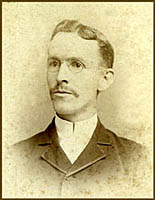
- During the final month of the Civil War it was occupied by Major James C. Hill, 46th Virginia Infantry Regiment, who had been severely wounded in the arm at Harrison’s Creek, near Petersburg, the previous June. He was visited by Generals Sheridan and Custer who decided not to arrest what they presumed was a dying man. However Major Hill survived and, after the War, became editor of the Scottsville Courier.
- Chester, which today offers exclusive bed and breakfast accommodation in quite delightful surroundings, keeps this Civil War history alive by hosting occasional re-enactments and encampments in its seven-acre grounds. Craig Stratton, the proprietor, greeted us most warmly and generously presented me with a copy of Scottsville on the James, by Virginia Moore, The Dietz Press, Reprinted 1994.
- Although a Southerner wrote this excellent history of Scottsville it contains some very complimentary references to GAC, which include him “handling a poor horse superbly” and “Custer especially took their eye. His swashbuckling ways so astonished them they would not be too surprised, eleven years later to hear that, fighting Sioux on the Little Big Horn in Montana Territory, he had led out 226 (sic) cavalrymen to be slaughtered by a much larger force. Or that, whereas the Indians hacked up the other bodies, they left his undisturbed.”
- Major Hill’s arm never did heal and in 1874 required amputation, elevating him to near hero status among the townsfolk of Scottsville for his Civil War sacrifices. He died in 1906.
Major James Christian Hill (1831-1906). Scottsville Museum Collection.
[20] The Fritz Sisters - A surprising connection!


(above) Catherine Francis Fritz (1861-1886) and (left), her sister, Louisa Sophie Fritz (1857-1882).
- A surprising connection between Lt. John W. Wilkinson, Company L, 7th U.S. Cavalry, a “hero” at the Battle of Canyon Creek, M.T. and James J. Dolan, the “bad boy” of the Lincoln County War, NM. A profusely-illustrated article about Lt Wilkinson’s incredible life is scheduled to be published in The Custer Association of Great Britain’s annual journal, The Crow’s Nest, for 2026. Full details will be posted on page ‘CAGB Online’.