Text to be added

Water Carriers Ravine - Little Bighorn Battlefield National Monument.
Non-UK Members of the 7th U.S. Cavalry
- CONTENTS
- 1. First Sergeant Joseph McCurry, Company H
- 2. Private Edward Diamond, Company H
- 3. First Lieutenant Donald McIntosh, Company G
- 4. Private Garrett H. Van Allen (real name Gerrit Houghtaling Niver), Company C
- 5. Private James Thomas (real name Thomas James Stowers), Company B
- 6. Private Ernest Wasmus, Company K
- 7. Corporal Daniel Nealon, Company H
- 8. Wagoner Albert Whytefield (real name Albert Schenke), Company K
- 9. Sergeant John Vickory (real name John H. Groesbeck), Company F
- 10. Henry T. McBratney – Citizen Packer with General Alfred Terry’s Dakota Column
- 11. Private Gabriel Gessbacher (real name Guessbacher), Company I
- 12. Private Morris Farrar, Company C
- 13. Private Abram B. Brant, Company D
- 14. First Lieutenant Charles C. De Rudio, Company E
- 15. Trumpeter Henry C. Dose, Company G
- 16. Private Martin McCue, Company K
- 17. Private William George, Company H
1. First Sergeant Joseph McCurry, Company H
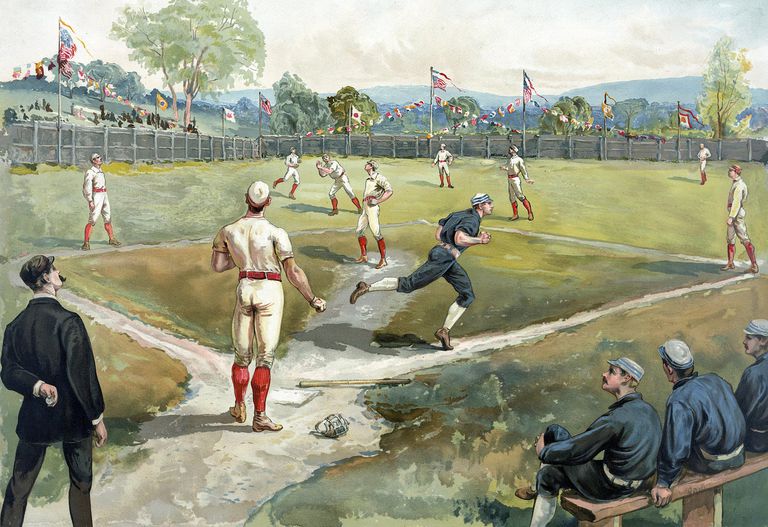
A late 1800s lithograph of a baseball game.
- Theodore Ewert, Company H, 7th U.S. Cavalry, confided to his diary1 that “McCurry delivers a swift and correct ball, generally to suit the batter, is a sure base runner, briskly if it pays, earns his runs, and is a gentlemanly player withal….He is undoubtedly the stay and prop of the club, and is also the best player.”
- Joseph McCurry, son of Irish immigrants, was born in Philadelphia, Pennsylvania, mostly likely in 1853, not three years earlier as virtually every biographer has led us to believe.
- He was enlisted into the U.S. Army by Captain Samuel Whitside on 22 January 1872 in Philadelphia, at a stated age of 21, and described as having brown eyes, dark hair, a ruddy complexion, standing 5’ 7” tall, previously employed as a coach maker. From Philadelphia McCurry was sent to the St Louis Depot, Missouri where, on 2 February 1872, he was transferred via the General Mounted Recruiting Service to the 7th Cavalry and assigned to Captain Frederick W. Benteen’s Company H, which he joined in Nashville, Tennessee, ten days later. He was promoted to corporal on 20 August the same year.
- On 1 March 1873, while still stationed in Nashville on Reconstruction duty, Company H decided to organize a club with the view of having games, sports, and exercises to be known as the “Benteen base ball and gymnasium club.” Joseph McCurry was elected as treasurer. It is interesting to note that leadership, military and sporting, among the enlisted men of Company H rested in the hands of McCurry – team captain, club treasurer, star pitcher, leading actor of the Fort Rice Minstrels theatrical group, which also performed at Fort Lincoln and Bismarck, and last, but no means least, its future senior NCO. He participated in the Yellowstone Expedition campaign against the Sioux later that year.
- Joseph McCurry was appointed sergeant on 1 July 1874 and served with his company in the famous Black Hills Expedition.
- In addition to its athletic program, the troopers of Company H also organized a glee club. According to the Ewart diary, one of their performances in the Black Hills for Samuel June Barrows, correspondent for the New York Tribune, was rewarded with two bottles of whiskey. They also sang several times in Yankton during the spring of 1875.
- Yankton Daily Press and Dakotaian, 25 May 1875.
- “We were favored last evening with a delightful serenade from a glee club organised by members of Co. H, 7th cavalry. It was a most agreeable interruption to our nightly labor and we thank the singers for thus kindly remembering us. If Yanktonians want to enjoy some of the best vocal music extant we recommend them to make friends with the Co. H boys. The following gentlemen comprise the membership of the glee club: 1st Sergeant — Theodore Covers; Sergeants — P. H. Rooney, Joseph McCurry; Farrier — John. M. Marshall,2 Privates – Alonzo Plumb,3 Charles W. Lange, Alexander Bishop, Charles Bishop. It is hoped that we may have them here on a concerting visit soon. If they remain at Randall they will endeavor to favor Yankton with a couple of entertainments.”
- Yankton Daily Press and Dakotaian, June 14, 1875
- “The McDougall4 Base Ball Club played the Randalls [Benteen Base Ball Club] a close contested game on the 8th inst. The score stood, Randalls 32, McDougalls 19. The Randalls improved on McCurry’s swift pitching, while the fielding of the McDougall nine was miserably poor.”
- Bismarck Weekly Tribune, 27 November 1875
- “Fort Rice Ministrels – The Fort Rice boys have organized a minstrel troupe consisting of the following persons, some of whom are known to our people as artists of unusual merit: — Joseph McCarthy [McCurry], right end; Alonzo Plumb, left end; James Tanner,5 interlocuter; William F. Davis; S. G. Mawson; Thomas G. Meader6; A. B. Bishop; John M. Marshall; J. M. Walsh and James Stringer. They expect to give their first entertainment about Dec. 10th, and hope to visit Bismarck during the winter.”
- On 1 October 1875. Joseph McCurry was promoted to 1st Sergeant of Company H.
- Bismarck Weekly Tribune, 15 December 1875
- “The Fort Rice Minstrels will give their first entertainment on or about Dec. 18th, at the Opera House, Fort Rice. Judging from their programme, a rich treat is promised. They may be expected at Bismarck at an early day.”
- Bismarck Weekly Tribune, 12 January 1876
- “Sergt. McLaughlin was in the city from Fort Rice Saturday. He says the Minstrels took in $150 at their last entertainment. The programme was acted to perfection. Lowenstein’s Garden, by McCurry and Plumb could not have been excelled in any country. They will appear at Bismarck in a few days.”
- Bismarck Weekly Tribune, 26 January 1876
- “The Fort Rice Minstrels did themselves credit in their performance last night. McCurry, Plumb and Bishop were encored again and again. The house was full, – packed and jammed to such an extent that, other ventilation being defective, several panes of window were broken. When the boys come again they are certain to secure a full house.”
- Bismarck Weekly Tribune, 16 February 1876
- “Sergt. McCurry and Plumb, of Fort Rice Minstrel fame, are in town, making preliminary preparations for an entertainment next Monday or Wednesday night. They will perform at Rice tomorrow night.”
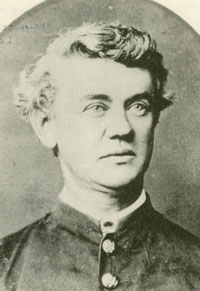
Captain Frederick W. (1834-1898), Commanding a battalion (Companies D, H and K) at the battle.
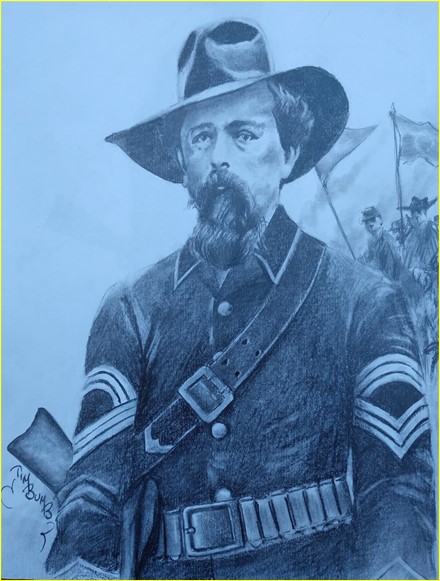
Sergeant Major William H. Sharrow (Courtesy of Tim Bumb).
- McCurry participated in the hilltop fight at the Little Bighorn where he received a gunshot wound in his left shoulder on the second day of the battle but remained in the field. On 1 August 1876 he was transferred the Non-commissioned Staff appointed sergeant major to replace British-born William H. Sharrow7 who had been killed with Custer.
- Due to one member of the team being killed6 and four wounded, including McCurry,7 the Benteen Base Ball Club never played another game after the Little Bighorn.
- McCurry has been suspected as the author of the notorious Reno petition, because of a perceived similarity of his handwriting with that of several of the alleged signatures, although the evidence is far from conclusive.
- On 2 October 1876, for his own reasons, McCurry reverted to 1st sergeant from sergeant major. He was discharged by expiration of service on 22 January 1877, at Fort Rice, as a 1st sergeant of excellent character.
- Contrary to what was originally published by Kenneth Hammer, and perpetuated by subsequent generations of authors, McCurry did NOT live at 4820 Oliver Street, Philadelphia, but [according to the United States Census, 1880] he WAS a boarder in the house of Harry Stafford, 1946 North 10th Street, Philadelphia, working in a carriage factory. He died, unmarried, of phthisis pulmonalis (TB) on 20 August 1883 in Philadelphia – address given as 1946 North 10th Street – and buried three days later in the city’s Cathedral Cemetery.9 The plot number is not known.
- Joseph McCurry’s age is shown as 27 in the 1880 census and 30 in the Philadelphia death records, which makes it seem very probable that he did, indeed, increase his age by two, or possibly three, years at enlistment to meet the minimum age requirement, i.e., 21. Writing in early 1876, Theodore Ewert gives McCurry’s age as 23, which supports the hypothesis that he was born in 1853, NOT 1850, as is published in two of the four books featured above.
- Notes and Sources
- 1. Theodore Ewert, originally from Prussia, author of Private Theodore Ewert’s diary of the Black Hills expedition of 1874, was discharged at Fort Rice with the rank of sergeant on 10 February 1876. He enlisted in the 5th Infantry on 15 February 1878 and discharged five years later at Fort Keogh, Montana Territory, a sergeant major of excellent character. He died 27 November 1906 at Quincy, Illinois.
- 2. Farrier John M. Marshall, Company H, who claimed to have been born in Scarborough, Yorkshire, though his true identity has not been verified, was absent sick in the post hospital, Fort Rice, on 5 May 1876 and he did not participate in the Little Bighorn campaign.
- 3. Private Alonzo Plumb was described by Ewert – ‘as “right field, the funnyman,” don’t profess to play base ball, but thinks he can keep the “nine” in a good humorous vein, thus in good working condition. He is from Ohio, catches pretty fair, is ambitious, but says himself that baseball is not “his forte,” but is on hand when “the laugh comes ”’ He was discharged April 3, 1876, at Fort Rice. He later served in the 1st and 10th U.S. Infantry, and discharged on disability in Washington, D.C. on 13 February 1891. Sadly, Plumb died, age 43, in an asylum for the insane on March 1, 1893 and buried in Saint Elizabeths Hospital East Cemetery, Washington, D.C., where a small military-style headstone marks the spot.
- 4. Lieutenant Thomas Mower McDougall, born Fort Crawford, WI, Company E, 7th Cavalry. He was appointed captain on 18 February 1876 and assumed command of Company B, which provided the pack train escort at Little Bighorn.
- 5. Real name Jacob Henry Gebhart, a private, Company M, from Altoona, Pennsylvania, killed in the hilltop fight at the Battle of the Little Bighorn, 26 June 1876.
- 6. Private Thomas E. Meador (correct spelling), Company H, from Bedford County, Virginia, also killed in hilltop fight, 26 June 1876.
- 7. Sergeant Major William Hunter Sharrow, born 2 March 1845, Sheriff Hutton, Yorkshire, England.
- 8. Private William Davis, from Vandalia, Illinois, Company E, killed with Custer’s column.
- 9. All Company H, 7th (i) 1st Sergeant Joseph McCurry, see above; (ii) Corporal Alexander B. Bishop, from Brooklyn, New York, wounded in right arm in the hilltop fight, and taken on the steamer Far West to Fort Lincoln; (iii) Private Charles H. Bishop, from Washington, D.C., wounded in the right shoulder but remained in the field; (iv) Private William C. “Fatty” Williams, born Wheeling, Virginia, wounded in the left leg, also remained in the field.
- 10. Pennsylvania, Philadelphia City Death Certificates, 1803-1915.
- Obituary – Theodore Ewert – 27 November 1906 (11 March 1847-27 November 1906)
- Colonel Theodore Ewert, who served in the civil war and later in the regular army, and who was for twenty years connected with the Illinois National guard, died Wednesday morning at the Illinois Soldiers’ and Sailors’ Home at Quincy, of which he had been an inmate since last spring. The funeral will take place at the cemetery of the home this afternoon, and the interment will be at the cemetery of the home. The services will be under the auspices of the Grand Army of the Republic. Colonel Ewert died as the result of a general breaking down of his mental faculties and the system in general. He was 64 years old.Colonel Ewert was a native of Prussia, but came to this country when a youth. On Aug. 9, 1861, he enlisted in Thielman’s cavalry, and re-enlisted Feb. 14, 1864. He was commissioned second lieutenant of the Twelfth United States colored heavy artillery on July 9, 1864, and was mustered out April 11, 1865, at the end of the war. Jan. 24, 1867, he enlisted in company H of the Thirty-sixth United States infantry and was discharged as corporal Jan. 24, 1869. He again enlisted, this time in the seventh United States cavalry, April 1, 1871, and was discharged as sergeant April 10, 1876. April 15, 1878, he enlisted in the Fifth United States artillery, and was discharged as sergeant major April 14, 1883.
- Colonel Ewert on his discharge from the army in 1883, came to Springfield and was appointed a clerk in the office of the adjutant general. Aug. 30, 1883, he was commissioned captain of Troop C, First cavalry, Illinois National Guard. He resigned Oct. 10, 1884, to accept the position of captain and adjutant of the Eighth Infantry, I. N. G., being commissioned as such Oct. 18, 1883, to rank from April 30, 1883.
- March 15, 1885, he was commissioned as acting assistant adjutant general and on July 1, 1885, as assistant adjutant general with rank of colonel, serving until his successor was appointed in June, 1889. Dec. 30, 1889, he was commissioned as captain of Company C, Fifth Infantry, resigning May 16, 1890. May 4, 1891, he was appointed assistant adjutant general of the Second brigade, with the rank of lieutenant colonel. He resigned this position Oct. 4, 1892. All this time he was connected with the adjutant general’s office, remaining there until the accession of General Alfred Orendorff as adjutant general in the spring of 1893. He was commissioned Captain and adjutant of the Fifth Infantry, July 14, 1896, holding the position until April 19, 1902, when he was appointed assistant adjutant general, holding that position until General Scott was appointed adjutant general in 1905, when he became custodian of the state arsenal. When his health failed last spring, he was sent to the Illinois Soldiers’ and Sailors’ Home at Quincy.
- Colonel Ewert was twice married. His first wife died several years ago, and he married Miss Nellie Bell, daughter of Colonel John C. Bell of this city, who survives him, together with one son, Frederick Ewert, now residing in Chicago and one daughter, Miss Etelka Ewert, both children by his first wife. Colonel Ewert was a member of the G. A. R. and of the Modern Woodmen of America. Pub. in the Illinois State Register, Springfield, IL 12-4-1906
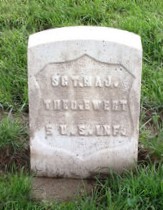
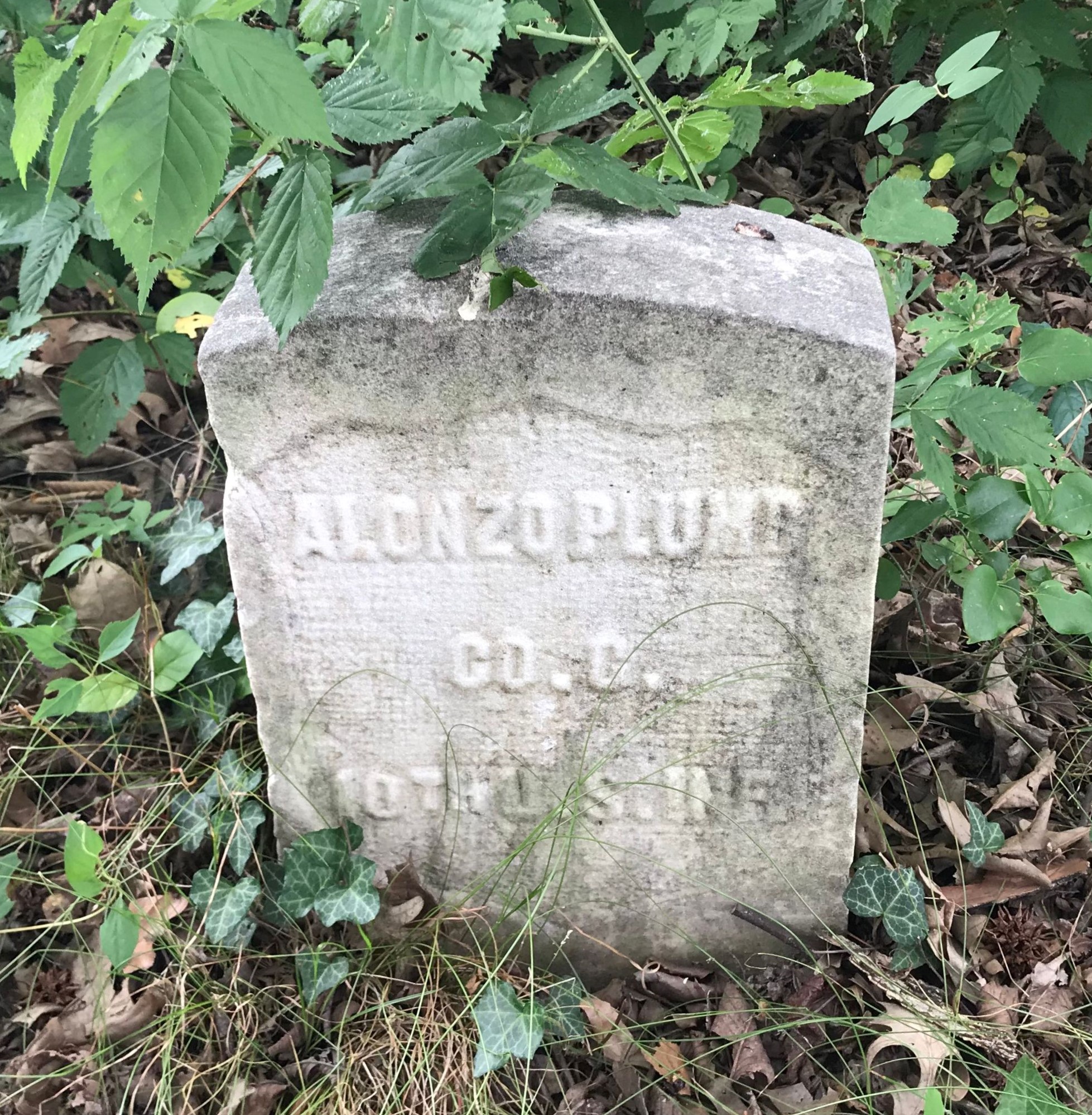
(Above)Headstone of Private Alonzo Plumb. (Left) Headstone of Sgt Maj. Theodore Ewert.
2. Private Edward Diamond, Company H

The Town of Stoughton, Massachusetts, sign.

The Depot, Stoughton, Massachusetts (1888).
- As far as this writer is aware only one member of the 7th U.S. Cavalry had the distinction of their birthday falling on the first day of the Battle of the Little Bighorn.1 I refer to Private Edward Diamond, Company H, from the Town of Stoughton, Norfolk County, Massachusetts.
- However, while Men With Custer: Biographies of the 7th Cavalry (1995), p. 90, Kenneth Hammer, gives Diamond’s date of birth as 25 June 1854, Military Register of Custer’s Last Command (2009), p. 109, Roger L. Williams, and Men With Custer: Biographies of the 7th Cavalry (2010), p. 102, Edited by Ronald H. Nichols with Daniel I. Bird, each show 11 June 1853, and Participants in the Battle of the Little Big Horn (2016), p. 35, Frederic C. Wagner III, hedges its bets by quoting “both dates have been listed.” All a little confusing.
- Edward Diamond (aka Dimon, Dimond) was, indeed, born on 25 June 1854 in Stoughton,2 the sixth of seven children to Irish immigrants, Hugh Dimond,3 a boot maker, and Sarah McGuiness (aka Maginnis). Sarah died of cancer on 11 September 1862 – she was only 47 years of age.4
- A young Edward was still living in the family home in 1865 but nothing further is known of him until 18 September 1875 when he was enlisted in United States Army in Boston, Massachusetts, by Lt Henry Lawton and described as having grey eyes, dark brown hair, a ruddy complexion, 5′ 5 3/4″ tall, age 22 (actually 21), previous occupation, a crimper in a boot making company. On 13 October, along with several other new recruits, including Private Timothy Donnelly,5 he was sent to the St Louis Depot from where he was transferred from the General Mounted Recruiting Service and assigned to Company H, 7th Cavalry, eight days later. Company H, under the command of Captain Frederick W. Benteen, was stationed at Fort Rice, Dakota Territory, and Diamond arrived at the post on 29 October.
- From 15 March to 4 May 1876 Diamond was on detached duty as a labourer with the Quartermaster’s Dept until Companies H and M left Fort Rice for Fort Lincoln to join the rest of the regiment as part of Brigadier General Alfred H. Terry’s Dakota Column. At the Battle of the Little Bighorn, he rode with his company in Benteen’s battalion and fought on Reno Hill. Charles Windolph, the last survivor of men in the 7th Cavalry who participated in the battle, said that on Reno Hill Company H was behind a horseshoe facing south and toward the river. This position was the most exposed to enemy fire and not surprisingly this company suffered by far the highest number of casualties.6 Diamond was fortunate to have survived unscathed and almost certainly numbered among the fourteen troopers from Company H left in the saddle, three of whom were wounded, in the first party to visit the Custer battlefield after the battle.7

Private Timothy Donnelly (1857-1876), Company F, 7th U.S. Cavalry, killed at the Battle of Little Bighorn.

(Captain Frederick W. Benteen (1834-1898), Company H, 7th U.S. Cavalry, as he would have looked at the time of the battle.
- Edward Diamond found himself in confinement on 28 November 1876 and again on 28 December, when he was sentenced at a general court martial to forfeit $10 (out of $13) pay for three months (offence not known). From May 1877 to January 1878, he was in confinement at Fort Lincoln awaiting trial (again offence not known) and consequently did not participate in the Battle of Canyon Creek, Montana Territory, against Chief Joseph’s Nez Perce Indians on 13 September 1877. He was at Fort Rice on 4 February 1879 and from April to August on detached duty as company cook. On 17 September 1880 he discharged at Fort Meade, Dakota Territory, a private of only a “fair character”.
- Three months later, on 21 December 1880, Diamond enlisted in the Marine Corps, in Boston, and for the first two years served mainly at the Marine Barracks there and on the barrack ship USBS Wabash. He went absent for 44 hours on 15-16 July 1881, for which he was confined for 13 hours on the 17th. He was discharged on 28 December 1885 at Mare Island, California, upon expiry of service.
- Perhaps dissatisfied with civilian life, on 5 October 1887 Diamond was enlisted in the United States Army in Boston by Captain William A. Miller, and assigned to Company F, 12th U.S. Infantry. His age given as ’34’, his place of birth as ‘East Stoughton’ and his occupation as ‘Mass[achusetts]’! Perhaps he genuinely believed he was born in 1853. There is no record of him being incarcerated during this second stint in the army and he was discharged twenty-one months early on 4 January 1891 at Fort Lincoln, North Dakota, a private of “excellent character.”8
- Men With Custer, p.103 (Nichols), speculates that “[Diamond] possibly worked as a stagecoach driver after discharge and was killed by Indians or outlaws.” This writer considers that after thirteen years of military service he may well have grown tired of being in uniform and decided to go under an assumed as, at the relatively young age of thirty-six, he simply wanted to start a new life. It is most unlikely that we shall ever know and his ultimate fate therefore must remain a mystery.

(Above) Colonel Guy V. Henry, 40th Massachusetts Volunteer Infantry. (Right) Headstone of Sergeant Hugh Dimond, Company F, 40th Massachusetts Volunteer Infantry, St Mary's Cemetery, Randolph, MA.

- Notes & Sources:
- 1. 25 June 1876, Montana Territory.
- 2. Massachusetts Births, 1841-1915.
- 3. Hugh Dimond (aka Dimon, Diamond) was born in Ballynahinch, Co. Down, present-day Northern Ireland, on 3 August 1822. On 22 June 1862, he enlisted in Company F, 40th Massachusetts Volunteer Infantry and was with his regiment at Cold Harbor, Virginia, on 1 June 1864 when Colonel Guy Vernor Henry’s bravery was awarded with a Medal of Honor. The citation reads: “Led the assaults of his brigade upon the enemy’s works, where he had two horses shot under him.” Henry is remembered for the part he played in the Battle of the Rosebud, Montana Territory, 17 June 1876 when he was shot in the face and badly wounded. Hugh Dimond was mustered out of the 40th Massachusetts on 30 June 1865, with the rank of sergeant. In late 1865 or early 1866 he married Mary Currivan, née Harney, who brought three children into the marriage. Mary was the widow of Private William Currivan, 56th Massachusetts Volunteer Infantry, killed in action in 1864. A daughter, Hannah, was born in Stoughton on 6 October 1866 and died in Randolph, Massachusetts, of ‘lung fever’ on 16 October 1868. Hugh Dimond died of sunstroke on 18 September 1881 in Randolph (Massachusetts Deaths, 1841-1915), and is buried in St Mary’s Cemetery, where a small, weathered military-style headstone marks the spot.
- 4. Massachusetts Deaths, 1841-1915
- 5. Private Timothy Donnelly, Company F, 7th Cavalry, born in Darlington, Co. Durham, also a son of Irish immigrants, was killed with Custer’s column on the first day of the Battle of the Little Bighorn. He had been enlisted by Lt Lawton at the same recruiting office in Boston three days after Diamond, and they travelled together to the St Louis Depot.
- 6. One officer and 19 enlisted men (excluding the five companies in Custer’s column).
- 7. Military Register, p 379.
- 8. GO 80, HQ Army, AGO, 26 June 1890, in accord with Section 2 of the act of Congress approved on 16 June 1890, provided for furlough and discharge of certain soldiers, who on that date had served faithfully three years or less and on their own application received furlough not to exceed three months so dated to expire with discharge not later than the last day of third month following end of third year of enlistment, and not eligible to again enlist in the Army for one year from date of discharge (Military Register, p. 115).
3. First Lieutenant Donald McIntosh, Company G

'Men With Custer - Biographies of the 7th Cavalry', Edited by Ronald H. Nichols with Daniel I. Bird, CBHMA Inc., 2010, p. 264.
- Date and place of birth: It is widely stated that Donald McIntosh was born 4 September 1838 at Jasper House, Montreal, Quebec, Canada. Other references suggest it could have been at anytime from 1835 to 1840. In Lives Lived West of the Divide: A Biographical Dictionary of Fur Traders Working West of the Rockies, 1793-1858 (2013), Bruce McIntyre Watson says that Donald McIntosh was born in 1836, with a question mark! I think it is safe to say that he was NOT born in Montreal and possibly not even at Jasper’s House in present-day Alberta, but as no written record of his birth has been found the precise date and place must remain uncertain.
- Heritage: Donald’s parents were John (not James) McIntosh and Charlotte Robertson (not Robinson). He was almost certainly NOT “of the same Scotch family” as Sir James McIntosh, In the HBC records John McIntosh is styled a ‘Clerk in charge’, not a ‘Factor’.
- Church records: ‘Catholic Church Records of the Pacific Northwest. Oregon City’ (1984) – baptisms on 18 Sept. 1842 of Donald, aged 6, and John, aged 3, sons of legitimate marriage of John McIntosh and Charlotte Robertson (godmother was Betsy McIntosh); ‘Vancouver’. Volumes I and II (1972) – baptisms on 13 June 1845 of Jacobus [James], legitimate son of Jean McIntosh and Charlotte Robertson, born Oct. 23, 1843.
- The Catholic Church Records of St. James Church, Vancouver, now in Washington state – show that on 4 June 1848 Charlotte and three of her children, including Donald (aged 12) were confirmed.
- Death of father: John McIntosh was shot dead by a “Sickanie Indian” at McLeod Lake, present-day British Columbia, on 8 July 1844 when Donald might have been as young as four or as old as eight, but not fourteen!
- Headstone: Donald McIntosh’s headstone in Arlington National Cemetery is inscribed ‘Aged 36’ (see below), not 37 as the 1838 year of birth would suggest, which only adds to muddy the water.

Looking towards the site of the second Jasper House across the Athabasca River.
- Additional Notes:
- John McIntosh (1803-1844)
- 1836-1842 Clerk in charge Connolly’s Lake New Caledonia (now known as Bear Lake, British Columbia)
- 1842-1844 Clerk in charge Babines New Caledonia
- 1844 Clerk in charge McLeod Lake New Caledonia
- 1844, 8 July “…shot Dead by a Sickanie Indian”
- Fur Trade Family History: John McIntosh, HBC

Fort Vancouver, 1850.
- Additional Notes (Cont’d):
- James Lowe’s journal entry for June 12, 1845, records the arrival of the interior brigade with the “family of the deceased Mr. McIntosh” who were “brought down to be left here.” Thereby hangs a tale. John McIntosh, a part-Indian clerk who was described as “boastful and tactless,” had long served in New Caledonia. On July 8, 1844, he was shot to death by a Sekanis Indian while tending his fish nets at McLeod’s Lake during a time of famine. His wife, Charlotte Robertson, made secure both the fort and the Company’s property, including the furs, before abandoning the place with her family and the only other male employee. The reason for her being taken to Fort Vancouver is not stated in records thus far examined, but evidently the Company felt an obligation to provide for her. Her children in June 1845 were: Catherine (Kitty), ca. 14 years; Archibald, age unknown; Donald, ca. 10 years; Elizabeth, age unknown; John, Jr., ca. 5 years; James aged 1 year, 7 months; and Julia, age unknown. In addition, there was Marie, ca. 2-1/2 years, the natural daughter of John McIntosh by Nancy, a woman of the Carrier tribe. Mrs. McIntosh was still at Fort Vancouver with several children in 1850. At that time she seems to have been living inside the fort, and perhaps had done so since 1845. At least two of the sons [Archibald and Donald) later entered the [HBC] Company’s service.
- John F Noble (ca.1828- ?)
- According to the Catholic church records, in early February of 1852 Catherine (Kitty) McIntosh gave birth to a daughter; on May 6 Julia Catherine Noble was baptized and Kitty McIntosh was buried. Her daughter followed her to the grave in August of 1852. (Warner and Munnick, Vancouver, H, passim.) John Noble was a military commissary clerk at Columbia Barracks (Fort Vancouver) under Brevet Captain Ulysses S. Grant and later Captain Rufus Ingalls. Noble served in the First Oregon Cavalry during the Civil War. Archives West: John F. Noble papers, 1849-1950
- John F. Noble was an Indian agent, stock rancher, and U.S. Army officer who lived in Oregon and Washington State. He came overland in 1849 from Harrisburg, Pennsylvania, as a civilian traveling with the U.S. Mounted Rifle Regiment. He was married to Catherine McIntosh at Fort Vancouver in 1851, and engaged in a stock raising enterprise near The Dalles, Oregon, with Louis Scholl.
- 10 August 1857, Charlotte Robertson McIntosh (Donald’s mother) dies at Fort Vancouver.
- For a resume of Donald McIntosh’s army career, see ‘Nichols’ above.

First Lieutenant Donald McIntosh. Inscription on the headstone of Donald McIntosh and his wife, Mary "Mollie" Garrett, in Arlington National Cemetery, Section 1, Grave 107D (right).

4. Private Garrett H. Van Allen (real name Gerrit Houghtaling Niver), Company C

'Men With Custer - Biographies of the 7th Cavalry', Edited by Ronald H. Nichols with Daniel I. Bird, CBHMA Inc., 2010, p. 400.

The Niver-Eddy mausoleum, Elmwood Cemetery, Bethlehem, New York. The mortal remains of Gerrit's parents, David M Niver and Phoebe C. Houghtaling Niver, are deposited here.

Elmwood Cemetery, Bethlehem, Albany County, New York. The inscription reads: GERRIT H. NIVER - Killed in the Custer massacre on the Little Big Horn Dakota June 25 1876 Aged 30 years 4 mo. 25 days.
- Place & Date of Birth: Born 1 February 1846 (the indexes says 1843!), in Bethlehem, Albany County, New York and baptised Gerrit Houghtaling Niver on 1 May 1846 in the First Reformed Church, Bethlehem. Several censuses support 1846 as the year of his birth.
- Heritage: Gerrit’s parents were David M. Niver (1819-1906), a farmer, and Phoebe C. Houghtaling Niver (1819-1903). His mother was never was a “Van Allen”!
- Enlistment: He was enlisted in the U.S. Army in New York City on 2 October 1873, by Lt. Edward Hunter, 12th Infantry, in the name of Garrett H. Van Allen, when he gave New Brunswick, New Jersey, as his place of birth. His occupation is given as ‘Farmer’, most likely simply meaning he only “worked on a farm.” Interestingly, he is recorded as a “Clerk on Steam Boat,” in the Federal Census, 1870. No explanation has been found to why Gerrit Niver said his surname was ‘Van Allen’, which he ‘borrowed’ from his brother-in-law, Richard Van Allen, who had married his sister, Anna, in December 1869.
- Army Records: Williams was incorrect to list him as Private Garrett H. Niver as no-one of that name ever enlisted in the U.S. Army, whereas others placed too much faith in Hammer’s erroneous assumption that ‘Niver’ was the surname of his mother’s second husband – the good lady only had one husband, David Niver, Gerrit’s father. They were married on 26 October 1843 at the First Reformed Church, Bethlehem.
- Army Pension: His mother’s application for an army pension, dated 18 April 1892 (No. 548,585), was rejected on the grounds that her husband owned property which provided comfortable support and she was not dependent as contemplated by law. See below.

5. Private James Thomas (real name Thomas James Stowers), Company B

'Men With Custer - Biographies of the 7th Cavalry', Edited by Ronald H. Nichols with Daniel I. Bird, CBHMA Inc., 2010, p. 392.
- Place of Birth: Thomas James Stowers, who enlisted under the name of James Thomas, was born in Nashville, Tennessee, not ‘Bucks’ County, Pennsylvania, which most likely is a miss-reading of ‘Burk’ [Berks?] County, PA, as appears in the U.S. Army, Registers of Enlistments.
- Heritage: His parents, William Stowers, a nightwatchman/labourer, from Tennessee, and Emily Parrish from Virginia, were married in Sumner County, TN, on 31 January 1838. Thomas, their third child, had at least three brothers and two sisters. Emily Parrish Stowers died 11 July 1886.
- Civil War Regiment: He was mustered into Company D, 199th Pennsylvania Volunteer Infantry (not the 119th) on 3 September 1864 under his real name and mustered out on 28 June 1865.
- Army Records: Only Nichols correctly shows him enlisting as Private James Thomas on 1 December 1874.
- Death: Thomas Stowers died on 25 July 1933 in Baxter, Tennessee (Williams says it was the 26th – the date of his funeral) and buried in the Odd Fellows Cemetery there. It is true that he did survive the Battle of Little Big Horn, being firstly with the pack train and later in the siege on Reno Hill, but was neither the sole nor the last survivor.

Headstone of Thomas James Stowers, Odd Fellows Cemetery, Baxter, Tennessee.

Thomas Stowers in later life. Photograph courtesy of the late Michael Nunnally.
6. Private Ernest Wasmus, Company K

'Men With Custer - Biographies of the 7th Cavalry', Edited by Ronald H. Nichols with Daniel I. Bird, CBHMA Inc., 2010, p. 414.
- Jemima “Jennie” Beulah Cornell, the future Mrs Ernest Wasmus, was born in May 1854, in Ontario, Canada, daughter of David Cornell (Canada) and Margaret Jane Harvey Cornell (Ireland).
- Federal Census 4 June 1880 – Port Huron, St. Clair County, Michigan
- Mary Cornell, 46, Keeping House, with five boarders.
- Children: Jemima, 26, School Teacher; Meta, 22, Dressmaker; Allen, 19. Machinist’s Apprentice; Maud, 13, and niece, Kate McGraw, Dressmaker – all born Ontario, Canada.
- Marriage: Ernest Wasmus and Beulah Cornell, 13 November 1886 at St. Paul, Ramsey County, Minnesota.
- St. Paul Daily Globe, 14 November 1886
- Mr. Ernest Wasmus, chief clerk of the adjutant general’s office at Fort Snelling, and Miss Cornell, were married Friday. An elegant silver tea service was presented to the happy couple by Mr. Wasmus’ brother clerks.
- St. Paul Daily Globe, 12 April 1890
- HE IS STRANGELY MISSING.
Unaccountable Disappearance of Ernest Wasmus of 299 Pleasant Avenue
In a cosy little home at 299 Pleasant avenue, a young mother, tearful and tremulous, and a prattling babe, are awaiting the return of the husband and father, Ernest Wasmus, who has mysteriously disappeared. The mother, with intervals of tears, hopes he may yet return all right, and the child is scarce old enough to do aught than
vaguely wonder why it does not daily receive the caresses of its father. Wasmus is chief clerk of the adjutant general’s office, at the war building. On the first day of the month he left his home as usual, and so far as can be ascertained, no one has since set eyes upon him. A Globe reporter called upon Maj. Barber, acting adjutant general, yesterday afternoon, but that official could give us insight into
the cause of the disappearance. “Wasmus is a capable, efficient clerk,” he said, “and his place will be held open for him a reasonable time. I hope he may return and resume his duties as usual.” Last evening Mrs. Wasmus answered the ring of the Globe envoy at her front door. She was very much agitated and evidences the suffering she has undergone. Her knowledge includes nothing that would account for the absence of her husband, other than that he had complained of pains in his head, nervous headaches, and other evidences of mental trouble. It is possible, then, that in a temporary aberration of mind he wandered away and may return. Maj. Barber thought possibly a slight mental derangement was at the bottom of the case.*
About this city it was learned that Wasmus had a few debts, most of them being of the nature of outstanding paper upon which he had secured indorsements (sic). Lieut. Budy, of the mounted patrol, had indorsed for him, and Lieut. Cole, of the subsistence department, had also accommodated him in the same way. The amounts in these cases were very small, and would not, of themselves, account for the flight of Wasmus. It is possible that there are other accounts of a larger sum, and that his indebtedness preyed upon the mind of the missing man, in connection
with nervousness growing out of over work. But whatever may be the cause, his friends are a unit in expressing the hope that Wasmus may return at once.
Ernest Wasmus was a sergeant of K troop, Seventh cavalry, until 1883. In that year he came to St. Paul to a rifle contest, and through the influence of Capt. Davis was exchanged into the general service here. Upon receiving his present position he married Miss Cornell, of St. Paul, and has since resided here. - Note (*): In addition to insanity, other possible PTSD symptoms emerge from the Seventh Cavalry medical records. They include Little Bighorn survivor, Private Ernest Wasmus, who experienced insomnia when he was about to engage the Nez Perces a year after the battle. Among the more than 20,000 medical records, only one other case of insomnia occurred. Source: Health of the Seventh Cavalry: A Medical History, edited by P. Willey and Douglas D. Scott, 2015.
- St. Paul Daily Globe, 12 November 1890
- Mrs. K. Wasmus, teacher of Fourth grade, Madison school, to date from Oct.13, at schedule salary.

Historic Fort Snelling entrance.
- St. Paul Daily Globe, 9 November 1899
- ASKS FOR A PENSION
- Mrs J. Beulah Wasmus files an application with Gen. Lambert
- RECALLS A DISAPPEARANCE
- Nearly Ten Years ago Her Husband, then a Member of the Seventh Cavalry, but Serving In Department Headquarters Left His Office and has Never Been Seen Since— An Old Story
- An application was filed with Adjt. Gen. Lambert for a widow’s pension by Mrs.J. Beulah Waumus yesterday afternoon.* The application calls to mind the mysterious disappearance of Ernest Wasmus, who was for a number of years a clerk In the adjutant general’s office of the department of Dakota. One day he complained of a violent headache, put on his coat and hat, left the office and has never been seen since. Many different surmises were made as to the manner of his death, If he were dead, but his disappearance is a as much shrouded in mystery today as it was on the day he was missed by his family. Wasmus disappeared March 30, 1890, leaving his wife with three small children to support.** Mrs. Wasmus went bravely to work, securing a position as teacher in the Madison school and educating her children to the best of her means. Max Ernest Wasmus, her husband, was originally sergeant In Company K, of the Seventh cavalry, and resigned as sergeant to take a detached position In the adjutant general’s office. Accompanying Mrs. Wasmus’ application are affidavits from the colonel of the Seventh cavalry and others as to Wasmus’ record and as to the disability that he had incurred at the time of his disappearance.
- It was stated at the time that the domestic relations of the Wasmus family were all that could be desired, and that, in the absence of any cause for suicide, the affair was a most unaccountable one to the friends -of the family. Wasmus had, however; incurred some disability since his enlistment In the army in 1874, and was subject to violent headaches. Mrs. Wasmus is still teaching at the Madison school and lives in the Argyle apartment house.
- Notes:
- (*) This application for a pension was not successful but a second application filed on 7 March 1923 was approved.
- (**) At the time of his disappearance there was only one child to support, Margaret Alwaine, born 18 August 1887. However, his wife was five months pregnant with a son whom she named Ernest Louis, born 6 August 1890. Beulah Wasmus never remarried and lived for a further fifty-six years.
- St. Paul Daily Globe, 25 February 1900
- WASMUS’ LONG LUNCHEON
- He Started in 1890 and Has Not Yet Returned
- Judge Bazille yesterday in probate court appointed Mrs. Jennie Wasmus, the widow, as administratrix of the estate of Ernest Wasmus. The appointment recalls, an interesting story. Wasmus was for a considerable time chief clerk at the army building. March 31, 1890, he went out for lunch and has never been heard from since, although every agency was employed. He left two minor children, besides the widow, and an estate, consisting principally of $2,000 in life insurance.


Judge of Probate Edmund W. Bazille (c.1855-1922) in his office in the courthouse, St. Paul, Minnesota, 1900.
- Federal Census 13 June 1900 – St. Peter Street, St. Paul, Minnesota
- Beulah J. Wasmus, 40, a Widow, Teacher, born Canada East. Children: Margaret A., 12 and Ernest L., 9 – both born in Minnesota and both at school.
- Minnesota State Census 3 June 1905 – 561 Laurel Avenue, St. Paul.
- Beulah Wasmus, 50, Housewife. Children: Margaret, 17 and Louis, 14. Frank Bussell, 26, School Teacher, born Illinois.

561 Laurel Avenue, St. Paul, Minnesota. Beulah Wasmus and family lived here.
- Death: Beulah J. Cornell Wasmus, 25 July 1946, St. Paul, Minnesota. Her place of burial is not known to this writer
7. Corporal Daniel Nealon, Company H.

'Men With Custer - Biographies of the 7th Cavalry', Edited by Ronald H. Nichols with Daniel I. Bird, CBHMA Inc., 2010, p. 294.

Guest register for the Gilt Edge Hotel, Gilt Edge, Montana, 16 January 1898 - note Dan Nealon's signature.
- Daily Enterprise, 20 October 1884 – Livingston, Montana.
- The List of Letters Advertised at Livingston waiting for collection included the name of Daniel Nealon.
- Federal Census (1900) – Gilt Edge, Maiden, Fergus County, Montana.
- Daniel Nealon, a Quartz Miner, lodging with Thomas L. Burke, b. Rhode Island, October 1850, parents born in Rhode Island and New York.
- Fergus County Democrat, 22 August 1900.
- Daniel Nealon was the delegate for Maiden, Fergus County, at the Republican Convention.

Looking southeast on Main Street, Gilt Edge, circa 1905.
- Federal Census (1910) – School District 23, Fergus County, Montana.
- Daniel Nealon, a Farmer, single, age 60, both parents born in Ireland.
- Fergus County Democrat, 20 April 1916
- DANIEL NEALON DIES SUDDENLY
WELL-KNOWN OLD-TIMER WHO SERVED UNDER MILES AND CUSTER MUSTERED OUT.
While sitting in a chair at the Midway saloon yesterday morning, Daniel Nealon, generally known as “Cracker Box Dan,* fell over to the floor dead. Heart failure was the cause of death. Mr. Nealon was a widely known old timer and for many years was located at Maiden. He was a native of Rhode Island and came to Montana first forty-three years ago. He served with distinction in the army during several Indian campaigns, having fought under General Miles and Custer. He was a man whose word was always respected and was known far and wide as a brave, upright, industrious citizen. He went to Maiden soon after leaving the army and worked in the Spotted Horse for Mr. McAdoo for several years and also worked in the Maginnis mine. He was 69 (sic) years of age. While little is known as to his family he had many friends among the old timers and they are interesting themselves in seeing that his is given a proper burial
The arrangements for the funeral have not yet been completed.
- Fergus County Democrat, 27 April 1916
- FUNERAL OF LATE DAN NEALON FROM CATHOLIC CHURCH SATURDAY
The funeral of the late Daniel Nealon, the widely known pioneer and ex-solider (sic), was held from the Cotholic (sic) church at 2 Saturday afternoon. A number of old timers, friends and associates of the decedent, had charge of the arrangements.
An effort has been made to find Mr. Nealon’s discharge papers and other paper but they have not as yet been located. Any person having knowledge as to where Mr. Neulon kept his papers is requested to communicate the information to the Democrat.
- Fergus County Democrat, 29 June 1916
- George R Creel, Undertaker, paid $100 for Daniel Nealon’s burial.
- (*) According to Private John Burkman, Company L, papers, Nealon was known as “Cracker Box Dan” because he kept hid behind a cracker-box on Reno Hill. Source: Military Register (Williams), p.23
- Participants (Wagner), p.72 reads: “Possibly illiterate, though this is hard to believe for a corporal [sergeant effective from 1 September 1876]”. Wagner is right to query this as two Federal censuses (1900 and 1910) show that Nealon could both read and write (also, see signature above).
- Daniel Nealon never married. He was buried in Calvary Cemetery, Lewistown, Fergus County (no headstone). His date of birth and heritage remain uncertain.
8. Wagoner Albert Whytefield (real name Albert Schenk) Company K

'Men With Custer - Biographies of the 7th Cavalry', Edited by Ronald H. Nichols with Daniel I. Bird, CBHMA Inc., 2010, p. 425.
- Albert Schenke, alias Whytefield and Whitefield – A Timeline
- c.1845 – Born Prussia (Germany), not Sandusky, Ohio, son of Henry and Elmira Schenke.
- c.1856 – Arrives in the United States with both parents and a sister, Johanna (born c.1854).
- 1860 – 8 June Federal Census for Sandusky, Erie County, Ohio – Henry Schenke, 39, Painter, born Bavaria; Elmira, 48, wife, born Russia. Children: Albert, 15, born Prussia; Johanna, 6, born Prussia.
- 1863 – 19 October enlists under the name ‘Schenck’ in 12th Ohio Volunteer Cavalry and assigned to Company I.
- 1865 – 19 July mustered out of 12th Ohio Volunteer Cavalry, Sweet Water, Tennessee.
- 1866 – 11 September enlists in U.S. Army, using the alias “Whytefield” (said to be illiterate, which he may have been in English) in Detroit, Michigan, for five years. Age given as 20, a painter, with blue eyes, light hair, a fair complexion, 5’ 4 1/2” in height. Assigned to 7th Cavalry, Company K, which he joined at Fort Riley, Kansas, in October. On extra duty as a teamster in December.
- 1867 – 20 May deserted from a camp near Fort Hays, Kansas.
- 1873 – 7 July arrested at Sandusky. In confinement in Newport Barracks, Kentucky to 11 August when transferred under guard to Fort Lincoln, Dakota Territory.
- 1874 – 4 February transferred to Company K at Fort Rice, Dakota Territory, in confinement. 1 May sentenced by a general court martial to three years confinement, then dishonourable discharge. 20 June restored to duty (authorised by ‘General’ Custer) to accompany the Black Hills Expedition. 14 October unexpired portion of sentence remitted. November and December extra duty with QMD and on 1 December appointed company wagoner.
- 1876 – 15 June detached service at Powder River Depot thereby did not take part in the Battle of the Little Bighorn. 11 August detached service at mouth of Rosebud Creek. 12 – 28 September detached duty with QMD with 281 cavalry horses at Fort Lincoln. October dismounted teamster with QMD.
- 1877 – 23 June discharged at camp on Sunday Creek, “a wagoner of excellent character.”
- 1880 – Federal Census for 1515 Madison Street, Sandusky, Erie County, Ohio – Rochus Link, 33, a grocer, born Baden (Germany); Anna, wife, 29, born Maryland [the future Mrs Albert Whitefield], and cyhildren: Anthony, 9; Mary, 8; Oliver, 5; George, 1 – all born Ohio.
- c.1882 – Rochus Link dies – no details. Albert marries his widow, Anna Zellers.
- 1884 – Son, Albert Whitefield, born 20 June 1884 in Sandusky.
- 1885 – Daughter, Nora Whitefield, born 11 December in Sandusky.
- 1886 – 12 April U.S. Army Invalid Pension granted.g556
- 1894 – Michigan State Census Kalamazoo, Michigan – Albert Whitefield, age 46, Teamster; Anna, 44, wife. Children: Albert, 10; Nora, 8 (and three stepchildren but excl. Anthony).
- 1895 – Albert, Snr, a teamster, and family living at 1125 North Park, Kalamazoo.

Main Street, Kalamazoo, Michigan, ca.1899.
- 1899 – 20 July one-year-old son,Willie, dies.
- 1899 – Albert, Snr, dies in early November and buried in Mount Olivet Cemetery, Kalamazoo on 9 November. A Civil War style headstone shows his adopted surname incorrectly spelled as “Whitfield.”


(Above) Memorial stone of Anna Zellers Whitefield. (Left) Military-style headstone to her husband, Albert Whitfield (sic) - real surname Schenke, Mount Olivet Cemetery, Kalamazoo, Michigan.
- 1899 – 17 November Anna Whitefield applies for a U.S. Army widow’s pension, which was granted.
- 1900 – 13 June Anna Whitefield and her six children living at 1010 South Church Street, Kalamazoo. It is likely that Albert died there.
- 1905 – Anna Zellers Whitefield living with her son, George, at 508 West Willard, Kalamazoo.
- 1909 – Leona (Nora) Whitefield marries Nelson Gerow, age 22, in Kalamazoo, on 27 February.
- 1918 – 21 June Anna Zellers Whitefield dies of ‘General Debility’, aged 69 years and 23 days. Buried in Mount Olivet Cemetery, Kalamazoo.
9. Sergeant John Vickory (real name John H. Groesbeck)

'Men With Custer - Biographies of the 7th Cavalry', Edited by Ronald H. Nichols with Daniel I. Bird, CBHMA Inc., 2010, p. 404.

Clifton Park Baptist Church, Saratoga County, New York, built 1837. A young John Groesbeck and his family would most likely have attended services here.
- Contrary to popular belief, I have found no evidence to support the claim that John H. Groesbeck (alias John Vickory) was born in Toronto, Canada. Why would New Yorker (Saratoga County) Mariah Groesbeck travel 300 miles in the late 1840s to a foreign country to give birth to just one of her eight or nine children? It makes no sense, whereas to John Groesbeck, a deserter from a New York regiment in the Union Army, laying a false trail clearly does. After all, he has successfully managed to deceive almost the entire Custer community for more than the last 150 years! The fact that at the age of sixteen he enlisted for military service in nearby Utica, New York, adds credence to him being born in the United States NOT Canada. To say that Vickory was born in Toronto and sometime shortly afterward the family moved to Clifton Park, New York, is nothing more than a figment of Mary Thomas’s vivid and misleading imagination, see Canadians with Custer, 2012.
- As far as this writer is aware, Roger Williams (Military Register of Custer’s Last Command, 2009, p.141), is the only author to give Saratoga as Vickory’s place of birth though he does have him under the name of John H. Groesbeck, when no sergeant of that name ever served in the 7th U.S. Cavalry. Groesbeck is listed on the battlefield monument as JNO. VICKORY which is correct, as for the same reason John Stuart Stuart Forbes is shown as J. S. HILEY and Thomas P. Eagan as THOS. HAGAN.
- How and when William Groesbeck knew that his son had been killed with Custer at the Little Bighorn and why he waited over five years to file for an Army pension awaits further investigation.
- John H. Groesbeck (alias John Vickory) – a timeline
- 1840 – United States Census, Clifton Park, Saratoga County, New York – William Groesbeck, wife, Mariah, and three children under ten years old.
- 1847 – John H. Groesbeck born to William and Mariah Groesbeck. Almost certainly at Clifton Park on a date not yet verified.
- 1849 – 7 August, Clark V. Groesbeck (brother of John), drowns age 4 yrs 4 m 9 d and buried in Clifton Park Baptist Cemetery, Saratoga County (headstone)
- 1850 – United States Census, Russia, Herkimer County, New York, nr Cold Brook Post Office – William Groesbeck, 43; Mariah, 32, wife. Children: Emoline, 15, Abraham, 13; Malinda, 8; John H., 3; Nelson, 1.
- 1851 – 17 August, Mariah Groesbeck (mother of John) dies, age 34, buried in Clifton Park Baptist Cemetery, Saratoga County (headstone, see below).
- 1855 – New York State Census, Deerfield, Oneida County – William Groesbeck, 52, widower, Laborer. Children: Emeline, 20; Abram, 18, Laborer; Caroline, 13; John, 8, b. Saratoga County, New York; Nelson, 6; Nemiah, 3. All children born Saratoga County with the exception of Emeline, b. Monroe, New York. The family had been in Deerfield for two years.
- 1860 – United States Census, Russia Township, Herkimer County, New York, nr Cold Brook Post Office – William 52. Children: Caroline, 18; John, 13, Nelson, 11; Nemiah, 9.
- c. 1862 – William Groesbeck (father of John) weds Margaret Woodard, who brings three children into the marriage.
- 1863 – 23 November enlists as a private in Company H, 14th New York Heavy Artillery in Utica.
- 1865 – New York State Census, Williamstown, Oswego County – William Grosbeck (sic), 56, Laborer; Margaret, 30, wife. Children: Nelson, 16; Nemiah, 13; Ida 1 5/12. Stepchildren: Ella, 7; Harrison, 5; William, 3, children of Margaret.
- 1866 – 31 July, using the alias John Vickory, enlists in U.S. Army in Boston, Mass, and assigned to Company F, 7th Cavalry stationed at Fort Riley, Kansas.
- 1870 – United States Census, Williamstown, Oswego County, New York – William Groesbeck, 62; Margaret, 36, wife. Children: Ida 8. Stepchildren: Harris (sic), 11; William, 6, Walter, 4.
- 1875 – New York State Census, Williamstown, Oswego County – William Grosbeck (sic), 66, Laborer, Emily, 35, wife. Children: Niamiah (sic), 35, Laborer; Walter, 9; r Ella, 2 3/12. Stepchildren: William Grosbeck (Woodard), 11.
- 1876 – 25 June killed on Last Stand Hill in the Battle of the Little Bighorn, Montana Territory.
- 1881 – 27 September, William Groesbeck (father of John Vickory, alias John H. Groesbeck) applies for an army pension, which is rejected on the grounds that the claimant could not provide evidence that his son had been contributing to his support.
- 1887 – 19 February, William Groesbeck dies (Men With Custer, Nichols, 2010, p. 404, see above).
- From 15 March to 4 May 1876 Diamond was on detached duty as labourer with Quartermaster’s Dept when Company H left Fort Rice for Fort Lincoln to join the rest of the regiment to part of General Alfred Terry’s Dakota Column. At the Battle of the Little Bighorn, 25-26 June 1876 he rode with his company in Benteen’s battalion and fought on Reno Hill.
- According to Private Charles Windolph (the last member survivor of men who served in the 7th Cavalry at the battle) said he and [almost certainly Diamond] was among fourteen other troopers from Company H left in the saddle, three of whom were wounded, in the first party to visit the Custer battlefield after the battle (Military Register, p 379).
- Edward Diamond found himself in confinement on 28 November 1876 and again on 28 December, when he was sentenced at a general court martial to forfeit $10 (out of $13) pay for three months (offence not known). From May 1877 to January he was in confinement at Fort Lincoln awaiting trial (again offence not known) and consequently did not participate in the Battle of Canyon Creek, Montana Territory, against Chief Joseph’s Nez Perce Indians on 13 September 1877.
- Diamond was at Fort Rice on 4 February 1879 and from April to August was on detached duty as company cook. On 17 September 1880 he discharged at Fort Meade, Dakota Territory, a private of fair character.
- Three months late, on 21 December 1880 Diamond enlisted in the Marine Corps, at Boston, and for the first two mainly served at the Marine Depot, Boston, and USRS Wabash. He discharged on 28 December 1885 at Mare Island, California, upon expiry of service.
- Perhaps dissatisfied with civilian life, on 5 October 1887 he was enlisted in United States Army in Boston by Captain William A. Miller, and assigned to Company F, 12th Infantry. His age given as 34, his place of birth as East Stoghton and occupation ‘Mass[achusetts]’! Perhaps he genuinely believed he was born in 1853. There is no record of him ever being incarcerated during this second spell in the army and he was discharged twenty-one months early on 4 January 1891 at Fort Lincoln, North Dakota, a private of excellent character.
- Men With Custer (Nichols), p. 103, speculates that “[Diamond] possibly worked as a stagecoach driver after discharge and was killed by Indians or outlaws.” This writer thinks that he may have decided to go under an assumed as, at the relatively young age of thirty-six, he simply wanted to start a new life. It is most unlikely that we shall ever know. His ultimate fate must therefore remain a mystery.
10. Henry T. McBratney – Citizen Packer with General Alfred Terry’s Dakota Column
- Although Henry “Harry” McBratney played only a minor role in the Little Bighorn campaign in the spring of 1876 he appears in the four best-known biographical works, three of which give a different version where he was at the crucial time of the battle and the fourth does not offer any information. Men With Custer (Hammer) tells us that he was a packer with the pack train and in the hilltop fight; Military Register (Williams) states he drove pack mules alongside the wagon train during the march to the Powder River depot; Men With Custer (Nichols) says he was with the Terry/Gibbon pack train, while Participants (Wagner) provides nothing beyond his name. Nichols gives 1840 as his year of birth, Williams gives c. 1840, yet his headstone reads “1844” – all very confusing.
- It seems most likely to this writer that McBratney, the son of a Scots father and an Irish mother, was born sometime around 1840 in New York State, though the precise date and location remain a mystery.1 We know that in July 1860 he was a labourer living in the Jamaica district of New York,2 and in August 1870 a clerk working in St Louis, Missouri.3
- Army records show that in April 1876 he was hired in St Paul, Minnesota, by Lieutenant Eugene B. Gibbs, Acting Assistant Quartermaster, 6th U.S. Infantry,4 to pack supplies on public animals for the forthcoming Little Bighorn campaign for $50 a month and entitled to one ration a day, and transport back to St Paul if honourably discharged. In the event, he was transferred to Lieutenant Henry Nowlan, Regimental Quartermaster, 7th U.S. Cavalry. The Dakota column, which marched west from Fort Abraham Lincoln on 17 May, had 150 wagons pulled by 900 mules, i.e. six per wagon, and carried 250 pack saddles in the wagons in case pack trains were needed later. As we know, they were. McBratney almost certainly remained in the field until his discharge on 23 September 1876, when he received $138.33 in pay, but there is no evidence to suggest he participated in the battle or ever visited the battlefield.

'The Mandan Criterion', Saturday, July 5, 1879, Vol. 1. No. 7.
- After being discharged, McBratney gravitated to Bismarck but by early 1879 he had already opened a store in Mandan, on the west bank of the Missouri River, that was nothing more than a cluster of log shacks, partly tented wooden structures and a colony under canvas. The same year he went into partnership with a 29-year-old Canadian, Thomas Bush, and launched the Pride of the West Sample Room (see advertisement above) and later the popular Palace Restaurant, situated next door to the Opera House. There, customers were offered fine wines and liquors, fresh Milwaukee beer, a good cigar, a game of billiards and a “bang-up” meal!

An advert in the 'Bismarck Tribune' which ran for several months during 1881.

The Hagers Block, Mandan (1883) would have been well-known to Harry McBratney.
- On 29 February 1880 Thomas Bush had accepted a Leap Year proposal from Mary “Kittie” Lenehan, the daughter of Irish immigrants, at a ball held in the Northwest Hotel, Mandan, and they were married on 22 October the same year. Less than three weeks later the Bush and McBratney partnership was dissolved.
- Judging by the following piece in the Bismarck Tribune, 8 July 1881, the ex-civilian packer’s restaurant did not escape unscathed from the disastrous ice floods that hit Mandan in March and April that year.
- “Harry McBratney is never the man to bring up the rear, as anybody can see by taking a look at his place since he has had it fixed. The bar stands now along the east side, and is as well stocked and appointed as any in the territory. Where the old bar stood is being fitted up as a club and leading room, and the walls and woodwork throughout have been retinted and painted. No thirsty man is able to get by Harry’s now, in this hot weather, and don’t you forget it.”
- Sometime later McBratney found a new partner in Thomas Mahar, who also ran a billiard hall and pool room in the town with a man called Ed Drury. The following report is taken from the Bismarck Tribune, 29 September 1882.
- “When it comes down to enterprise Mandan doesn’t take a back seat for any of the towns in the country. Those who attended the opening McBratney & Mahar’s elegant billiard parlors last night, were surprised at finding a place that would be a credit to St. Paul or Chicago. The room is a marvel of neatness and good taste, with its new tables, furniture and the well-arranged bar. The wainscoting bar and refrigerator are finished in black and gold, with Japanese ornaments. Taking all together, Harry and Tom have a dandy place, and they are proud of it. A choice lunch was served, and champagne flowed freely at their opening last evening, and all drank to the success of “Harry and Tom’s place.”
- The year before, on 24 November 1881, Henry McBratney had married Mary Ann Butler, also the daughter of Irish immigrants, who came originally from New York.5 They made their home in Mandan until 1888 until they filed for homestead land in Township 138 Range 82, known as Custer Flats, six miles southwest of the town and built their first home there, a one room shack. Mary – and their five children: Edward R. (born 1883); Frances M. (born 1884); James H. (born 1886); Florence (born 1889); Robert T. (born 1892) – continued to live on the farm while her husband maintained his business interests in Mandan.
- Henry “Harry” McBratney died suddenly on 12 October 1892.

Notice in the 'Bismarck Weekly Tribune', 14 October 1892.
- Henry McBratney was laid to rest in Mandan Union Cemetery, where a fine grey granite headstone marks the family plot. His memorial tablet, which shows ‘1844’ as his year of birth, has a perfectly plausible explanation. Mary Butler, born 28 July 1854, was around fourteen years her husband’s junior and we should not be surprised therefore if he reduced his age by four years to ‘deceive’ his bride that he was younger than he really was. The word ‘Father’ was most likely added at the time of his wife’s death 45 years later.
- The fact that he ran a popular restaurant and his name often in the local newspapers, his service with the Custer expedition of 1876 was not mentioned, which supports Roger Williams’ thoughts that McBratney himself did not think his involvement in Little Bighorn campaign of June 1876 was sufficiently worthy of retelling the tale.

McBratney Family Headstone, Mandan Union Cemetery, Morton County, North Dakota.
- In spite of many hardships Henry’s widow carried on and over time bought more land until her property became a large ranch with a modern dwelling house and outbuildings. Tragedy struck the family on 20 September 1898 when after a three-day illness, twelve-year-old James died of bronchitis. He was buried in Mandan Union Cemetery. Mary McBratney also raised her grandson, Grenville Swanberg, a deaf and dumb child who was orphaned at a young age6 and, for several years, found time to be treasurer of the Highland township school district.

McBratney land (480 acres) in Township 138, Range 82, Morton County.
- Mary Butler McBratney, a devout Catholic, died aged 84, at home on 31 August 1938, and was laid to rest beside her late husband in Mandan Union Cemetery, where a tablet is engraved in her memory.

Memorial tablet for Henry T. McBratney, Mandan Union Cemetery. Note the year of birth, i.e., 1844.

Memorial tablet for Mary Ann (Butler) McBratney, Mandan Union Cemetery.
- Mary McBratney was survived by Edward Raymond (unmarried, died 6 March 1945), who ran the family farm, Florence (also, never married, died 9 December 1958), a teacher in Boulder, Montana, and Robert Thomas (died 26 September 1964), a rancher near New Salem, Morton County, who had married Margaret Magdalen Smith on 1 March 1916. As none of the three surviving children produced any progeny the McBratney surname became extinct with the death of Robert’s wife in Rapid City, South Dakota, on 1 February 1975. Robert and Margaret lie buried, in St Aloysius (Catholic) Cemetery, Sturgis, Meade County, South Dakota, where a double headstone was erected in their memory.

Headstone to Robert and Margaret (Smith) McBratney, st Aloysius Cemetery, Sturgis, South Dakota.
- Endnotes
- 1. U.S. Census, 1880, Dakota Territory, Burleigh.
- 2. U.S. Census, 1860, New York, Queens.
- 3. U.S. Census, 1870, Missouri, St Louis.
- 4. Aide-de-camp to General Alfred Terry on the campaign. Lieutenant Eugene Beauharnias Gibbs is remembered for rescuing a Blue Skye Terrier called “Smoke”, one of at least two canine survivors of the Little Bighorn, whose Indian master had been killed in the famous battle.
- 5. Bismarck Tribune, 2 December 1881.
- UNITED BLISS
- The Marriage of an Old Time Bismarcker by the Rev. Father Cassidy
- The Event Made Conspicuous by the Number Present and Presents Made
- A Good Time at Mandan.
- One of the most enjoyable social affairs of the season was the McBratney-Butler wedding Thursday Nov.24. Mr. McBratney is an old tried and true resident of the west; was formerly at Bismarck but for the past two years has lived and transacted business in this city, where his friends are only numbered by his acquaintances. The wedding ceremony was performed at the Catholic church, Rev.Cassidy officiating, and was very largely attended. Tommy Mahar acted as groomsman, and Miss Mary Lyons, of Bismarck, as bridesmaid. At 10 o’clock a GRAND RECEPTION was given at the home of Mr. and Mrs. McBratney, where a large concourse of warm friends assembled and gave evidence of their good wishes for the newly wed led pair by their offerings of numerous valuable and useful presents. After the reception, the wedding party adjourned to the dancing hall of the Mandan Social Club, where dancing was kept up until a late hour.
- (There followed an impressive list of the presents and the names of the donors.)
- 6. Grenville Clemens Swanberg (born 1914), son of John R. Swanberg (died 1921) and Frances M. McBratney (1915) both of whom are buried in Mandan Union Cemetery. Grenville died 1888, in Las Vegas, Nevada.
11. Private Gabriel Gessbacher (real name Guessbacher), Company I

'Men With Custer - Biographies of the 7th Cavalry', Edited by Ronald H. Nichols with Daniel I. Bird, CBHMA Inc., 2010, p. 139.
- Gabriel Guessbacher arrived in the United States from Bavaria in 1870. He enlisted in the U.S. Army under name of ‘Gussbacher’ in Philadelphia on 6 October 1873 and re-enlisted as ‘Geesebacher’ five years later. It is not surprising that his surname has been spelled in some many different ways. Gabriel G. Guessbacher became a naturalised U. S. citizen on 24 November 1896 at a stated age of 23. A little under twenty-two months later he filed a claim for land in Washington Township, Eddy County, North Dakota, which he farmed for several years. The 1900 Census for Eddy County says he was born in October 1843 and if correct would make him three years older than his age given on his first enlistment, which is far from uncommon for a new recruit in his late twenties.
- He was on detached service at the Powder River Depot from 10 or 15 June 1876 and consequently did not participate in the Battle of Little Bighorn. While at Powder River, Guessbacher said they had to sleep on the damp ground without covering, and he contracted rheumatism. John Shauer (a fellow Bavarian private in Company K), in affidavit, supporting Guessbacher’s claim for pension, said they camped at the mouth of the Powder River and for a week or more had wet weather, and not having tents they had to sleep on the wet ground. Shauer did not know Guessbacher at the time, but said what few men of Company I were left were camped there without tents (Source: Military Register of Custer’s Last Command, Roger L. Williams, 2009, p. 142, n. 38). Guessbacher applied for an army pension on 9 January 1899, which was abandoned.
- Claims to have witnessed the massacre of Custer’s five companies
- Sometime before 1910, Guessbacher, affectionately known as “Uncle,” owned and operated the Valley Grain Company at Warwick, near Devil’s Lake, ND. Although detached at the Powder River, he claimed to be one the few survivors of Little Bighorn who actually witnessed the “massacre of Custer’s command,” which is a figment of his vivid imagination (see his obituary below). Not far from the ex-trooper’s home, in his little tepee, lived Old Chief White Dog (age 41 in 1876?) who it is said led a group in the fight against Custer. It is ironic that these two veterans who were on opposite sides in June 1876 should live peacefully so far away from the battlefield within gunshot range of each other nearly forty years later.
- An obituary was published in the Ward County Independent, Minot, ND, 17 August 1916. In other reports and enlistments his name is spelled ‘Geisebacher’, ‘Guesaber’ and ‘Guesbacher’ and his age at death given as ’77 years’. The age inscribed on his headstone shows ’60 years’ though he was most likely thirteen years older.

Warwick Cemetery, Warwick, Benson County, ND, Plot: Block One - Plot 29.

Obituary of Gabriel Guesbacher (Guessbacher) in 'Ward County Independent', Minot, ND, 17 August 1916.
12. Private Morris Farrar, Company C
- Private Morris Farrar of Company C, 7th U.S. Cavalry, was the sole participant in the Battle of the Little Bighorn from the Southern Hemisphere, though he identified as American. His father, Joel, only son of John Farrar—a farmer of Scottish descent—and Eunice Cummings, was born on 20 August 1806 in Petersham, Worcester County, Massachusetts.
- At the age of seventeen, Joel left home to pursue a life at sea and was absent for more than twenty-five years, the latter period of which he spent in Australia. Farrar family history tells of him working for a Scotsman (Niel Black?) who ran a large sheep farm near Melbourne, Victoria, and marrying Rose Cameron from Ireland. There is nothing to suggest that the family was ever in New South Wales.
- While in Australia, Joel and Rose had at least two children, namely, David (born c. 1842) and Morris (born c. 1845), the subject of this paper.* At an unknown date, probably early in 1850, the family left Australia for England when a third child, Mary, was born at sea. On 21 August the same year Rose, five-year old Morris, and his two siblings sailed from Liverpool on the SS New World, which arrived in New York five weeks later – Joel having gone ahead to establish their home in Fitchburg, Worcester County.

- Tragedy struck the family in 1853 when David and Mary died of scarlet fever. A fourth child, Harriet, was born in West Fitchburg the following year. The Massachusetts Census of 1855 lists Joel Farrar, 40 (sic), a paper maker, Rose, 30, Morris 9, born Australia, and Harriet, 1, born Massachusetts. A fifth child, Gilbert, was born in Fitchburg in 1857. The U.S. Census of 1860 for Fitchburg shows M[orris] Farrar, 16, born Massachusetts!
- (left) A Civil War soldier. Morris Farrar, Company A, 53rd Massachusetts Volunteer Infantry, 1862-63. (Courtesy of Randall Carlson, Illinois)
- The year 1862 was particularly eventful for Rose Farrar. Her husband passed away from cancer in April and her son Gilbert tragically drowned in a boating accident in June. Subsequently, on 25 August, her only surviving son, Morris, who increased his age by two years, enlisted in Company A, 53rd Massachusetts Volunteer Infantry.
- The Fifty-third participated in the Bayou Teche Campaign and the Siege of Port Hudson in Louisiana. Farrar was mustered out of the regiment on 2 September 1863 at Camp Stevens, MA, and returned to Fitchburg. On 30 January 1864, he joined Company I of the 4th Massachusetts Volunteer Cavalry. His service included deployments in Florida, North Carolina, and participation in the Appomattox Campaign in Virginia, which effectively ended the Civil War on 9 April 1865. He was honourably discharged in Boston, MA, on 14 November that year.
- Farrar, a mechanic, married Irish-born Catherine “Kate” Tierney in Fitchburg on 4 February 1866. Their only child, Alice, was born there on 18 August 1869. The 1870 U.S. Census for Fitchburg shows Maurice (sic), age 25, working in a woollen mill. He enlisted in the United States Army in New York City on 23 January 1872, giving his occupation as grinder and, inexplicably, his place of birth as Amesbury, MA. Given that Amesbury is less than sixty miles from Fitchburg and famous for its textile mills, he may well have been living there at the time. He was described as having brown eyes, black hair, a dark complexion, and 5 feet 8¾ inches tall. From New York, Farrar was sent to the St Louis Depot, Missouri, before being transferred to the 7th U.S. Cavalry. He joined Company C in Rutherfordton, North Carolina, on 18 February 1872, which was engaged on Reconstruction duty. In the summer of 1873, he took part in the Yellowstone Campaign.
- On 9 May 1874, five-year-old Alice died from croup in Lowell, MA. Following her death, Farrar was assigned to detached service at Fort Rice, Dakota Territory (D.T.), from June to September that year to guard company property, which resulted in his absence from the Black Hills Expedition (2 July to 30 August). He served at the post’s headquarters from October 1874 to July 1875.
- Company C was part of Custer’s column, which left the divide around noon on 25 June 1876. It is speculated that Farrar may have dropped out along Reno Creek, likely making him the first to do so, which undoubtedly saved his life. He eventually joined Reno on the hilltop and survived the Battle of the Little Bighorn unscathed. He was appointed corporal effective from 1 September and further promoted to sergeant one month later. Farrar was discharged at Fort Totten, D.T., on 23 January 1877 on expiration of five years’ service, a sergeant of excellent character. From 1877 to 1880, he was employed as a wireworker in Fitchburg and lived at 94 Grove Street.
- On 1 September 1881, Morris Farrar re-enlisted in the U.S. Army in Boston as a former soldier with ‘blue eyes’ and a height of 5 feet 9 inches; again, giving Amesbury, MA, as his place of birth. Assigned to Company D, 17th U.S. Infantry, he deserted on 21 November while on detached service in Bismarck, D.T., likely concealing his identity to evade capture as he disappeared from all records until his death was reported in the Philadelphia Inquirer on 12 April 1899. It reads:
- DEATHS: FARRAR – On April 9, 1899, Morris Farrar. The relatives and friends of the family are respectfully invited to attend the funeral, on Wednesday morning, April 12, at 8.30 o’clock, from his late residence, 2420, Trenton Avenue, Thirty-first ward. Requiem mass at St Anne’s Church. Interment at Holy Cross Cemetery. Lowell Mass., papers please copy.
- Morris Farrar, a bridge builder, died at a reported age of 53, from cerebral congestion following capillary bronchitis and was buried in Holy Cross Cemetery, Philadelphia, PA. The death certificate names the deceased as Morris Mason Farrar, born Fitchburg, MA, which gives rise to the question, “Did Farrah use ‘Mason’ as an alias while on the run from the U.S. Army?” Yet another mystery waiting to be solved. A weathered headstone erected in his memory (right, courtesy of Rockon) is still standing though the inscription has long since become unreadable. Bearing in mind her husband was a deserter, Catherine Farrar was truly fortunate to be granted an army pension of $8 per month on 25 April 1899, based on his Civil War service. It was later increased to $16. Catherine, a housekeeper, died of heart disease at the age of 69 on 2 September 1916 in Dracut, MA, and interred in an unmarked grave in St Patrick Cemetery in Lowell, which lies on the opposite bank of the Merrimack River.

- (*) In Men With Custer: Biographies of the 7th Cavalry, (1995), pp. 104-5, Kenneth Hammer cites that Morris M. Farrar was “Born: July 30, 1846, Sidney (sic), Australia” yet no primary source is given, while in Military Register of Custer’s Last Command, (2010), p.123, Roger L. Williams, gives “Amesbury Mass” as his place of birth. Despite extensive research in Australia and by this writer, no record of Joel Farrar and Rose Cameron’s marriage or documentation for this trooper in that country has been found. Based on available evidence, Morris Farrar was most likely born in 1845 near Melbourne, Victoria, though this cannot be confirmed. The search continues.
13. Private Abram B. Brant, Company D
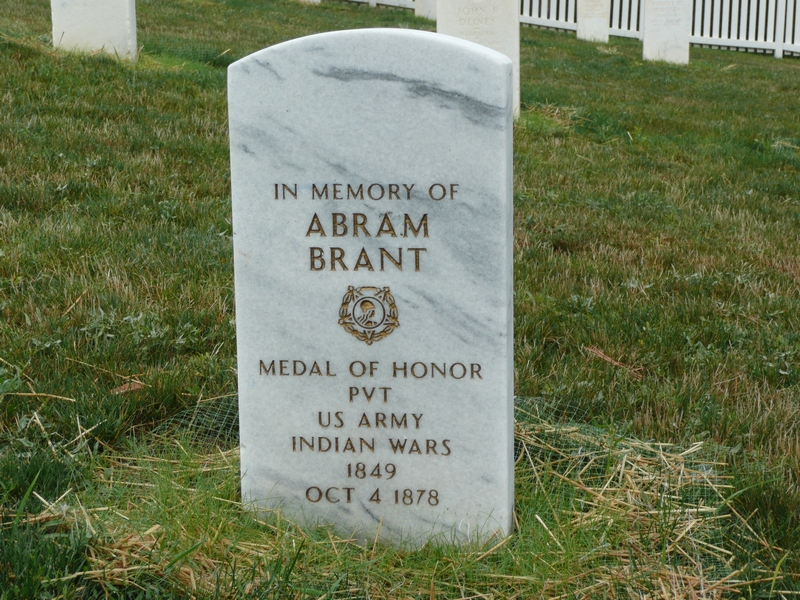
Memorial stone to Abram [B.] Brant - Fort Meade National Cemetery, near Sturgis, South Dakota. Courtesy of Scott Nelson.
- The fine photograph of the marker for Abram [B.] Brant, Company D, 7th U.S. Cavalry, in Fort Meade National Cemetery, Sturgis, South Dakota similar to the one that graced the front cover of the Little Big Horn Associate’s Newsletter (November 2008) rekindled pleasant memories of a fairly recent visit to this scenic part of the country, but it is the similarities between Brant and Private James Pym, Company B, that most caught my attention. For example, both men were awarded the Medal of Honor for bringing water to the wounded at the Battle of the Little Big Horn; both met violent deaths as a result of having been being shot at point-blank range;1 both headstones depict what is almost certainly an incorrect year of birth; and whereas the inscription on Pym’s stone displays an extraneous second initial ‘J’, Brant’s ‘ever present’ second initial ‘B’ is missing. As I had already researched Pym’s extraordinary life [see Biography No. 50], I was curious to find out more about Brant’s pre-7th Cavalry days and, in particular, if ‘Abram’ or ‘Abraham’ was his given name, in what year was he actually born, and why the traditional Christian cross motif had not been engraved on his headstone.2
- My first point of contact was John Saul, the best-selling author of suspense and horror novels, who is a direct descendant of Brant’s elder sister, Mary, and her second husband, the Reverend John Sargon Saul, a minister in the Swedenborgian Church. Apparently Mary graduated from the Dutch Reformed School, New York, in the same class as the fabulously rich Cornelius Vanderbilt II (1843-99), which suggests the Brants themselves were reasonably well heeled.
- Saul was quick to tell me that, as far as he was aware, the precise date, let alone the year, of his great-granduncle’s birth remains uncertain, which confirmed my suspicion that the year 1849 inscribed on the headstone was probably based on the age given on enlistment; regrettably, all too often an unreliable source. Saul went on to say that his Brant ancestors were most definitely members of a Protestant Church, thus dis-spelling the supposition that they may have belonged to a non-Christian faith, which would have accounted for the blank space near at top of the headstone where an encircled cross motif would normally be found.
- The next course of action was to check out the three decennial censuses that covered this trooper’s short life. The first, for Ward 17, on Manhattan’s lower east side, taken 29 July 1850, lists him as “Abraham Brant, age 3 years,” the youngest of five children born to John C. Brant,3 a (stone) mason from New Jersey, and his wife, Mary H. Brant, from New York.4 Long experience has taught me to treat census returns with the utmost caution but in this instance I saw no reason to doubt the veracity of this particular entry. After all, what possible motive would a highly respectable family like the Brants have in deliberately deceiving the census enumerator, not only by declaring that their youngest child was called ‘Abraham’ if his name was ‘Abram,’ but also by claiming the lad was three years-old if, in fact, he was more than three times less that age.
- By the time of the next census – 14 June 1860 – the family had moved to District 4, Ward 9, a more fashionable neighbourhood on Manhattan’s lower west side, and on this occasion we find “Abm. B. Brant, age 12,” which gives credence to the information contained in the earlier survey. Alas, what the initial ‘B’ stood for was never disclosed but, as his army records consistently show, it clearly became very important to the man himself.
- The third and last census of interest, taken on 19 September 1870, records “Abrm B. Brant, age 22 – Engineer Civil – born New Jersey,” lodging with Jacob and Elizabeth Beardslee at the Temperance House, Sparta Township, Sussex County, New Jersey. Again it flies in the face of reason to think that the census enumerator would omit just one letter, i.e. an ‘a’, when there was more than enough room on the page to write ‘Abram’ in full, which further convinces me that it was clearly a perfectly acceptable contraction of ‘Abraham.’ It is likely that the information was extracted from the lodging house’s register, which Brant may have signed two or three months before when he was still 22 and the Beardslees had no way of knowing (or caring) that he had since passed his 23rd birthday. We know he was born in the state of New York, not New Jersey, which makes this particular source somewhat less reliable than the previous two.
- While I would argue strongly that the above evidence fully vindicates my initial thoughts that Brant’s given name was not “Abram” but ‘Abraham,’ and “he was not born in 1849” but ‘1847’ (most likely June or July) I have absolutely no problem in accepting John Saul’s assertion that his collateral ancestor was known as ‘Abram’ within the family and beyond; in much the same way as Private Alfred E. Allen, Company C, was known as ‘Fred.’5 Undoubtedly he called himself ‘Abram B. Brant’ and we know that he joined the U.S. Army under that name at St Louis, Missouri, on 27 September 1875.6 By my reckoning he would then be in his 29th year – comparatively ancient for a first enlistment – and it should come as no surprise to discover that, like so many of his contemporaries, he felt the need to reduce his age to be more in line with of the majority of his fellow new recruits.
- Finally, Section 2 of the ‘Application for Standard Government Headstone or Marker,’ dated September 17, 2008, and submitted to the Department of Veterans Affairs, plainly shows “Abram B Brant” as the ‘name of deceased to be inscribed on headstone or marker,” which makes it all the more disappointing that the initial ‘B’, such an integral part of his name, should be so conspicuous by its absence from the memorial stone.
- It is hoped that at some time in the not too distant future a locally-based Custer enthusiast will track down that elusive entry in a New York City public record or church register which proves beyond doubt the correct date of birth and given name of the heroic private from Company D, 7th U.S. Cavalry, whose mortal remains lie buried in an unmarked grave somewhere within the hallowed ground of Fort Meade National Cemetery.
- 1. Brant died on 4 October 1878, at Camp Ruhlen, Dakota Territory, of an accident gunshot wound in the abdomen received while handing his revolver to a sergeant.
- 2. Compare with headstones of other LBH Medal of Honor recipients, e.g. Sergeant Benjamin C. Criswell, Company B, Pleasant Hill Cemetery, Harmon County, OK; Private James Pym, Company B, Custer County Cemetery, Miles City, MT; Private (later Sergeant) Charles Windolph, Company H, Black Hills National Cemetery, Sturgis, SD; etc.
- 3. According to notes from the obituary of one of his grand-daughters, John C. Brant was “a great friend of Horace Greeley, and provided the first capital to begin his paper,” i.e. the New York Tribune, which was established in 1841. Brant was a director of the Mechanics’ Institute, New York City (the New York Times, May 11, 1855).
- 4. The following obituary notice was published in the New York Times, September 29, 1869, it reads: “BRANT – At Jersey City, on Tuesday, Sept. 28, MARY H., widow of the late John C. Brant.” The date of death of Abram’s father is not known.
- 5. Alfred E. Allen, from Melton Mowbray, England, who enlisted under the name of Fred E. Allan, was killed with Custer’s column at the Battle of the Little Bighorn. See Biography No. 1.
- 6. Brant joined Company D at Fort Abraham Lincoln, Dakota Territory, October 21, 1875.
14. First Lieutenant Charles C. De Rudio, Company E

- While Charles De Rudio’s (left) personal and soldierly qualities may not been universally held the highest esteem among the officer corps of the much-celebrated 7th United States Cavalry, I have long been fascinated by his charmed and adventurous life, which would seem to be perfect material for a Hollywood movie. The fact that this charismatic Italian aristocrat, albeit a minor and impoverished one, married a feisty, working-class teenager from Nottingham and spent several years in England, has added a distinctly British dimension to my curiosity.A report in The Times, 18 April 1856, under the heading “Horrible Assassination in Rupert-Street,” says the attack took place the previous evening in a small restaurant there; while a question from the floor of the House of Commons to Sir George Grey, then Home Secretary (Hansard, 20 June 1856) refers to a “Murder in Panton Street.”
- So, when and where did this vicious assault take place? Did any of the injuries prove to be fatal? And, what did e Rudio himself have to say on the matter? As this area of London is well known to me I decided to undertake my own research in an attempt to find the answers to these questions and separate verifiable fact from the ever-growing mass of misleading fiction: it certainly proved to be an absorbing exercise. De Rudio’s version of the affair, as related to Cesare Crespi (Per La Libertà! 1913*), clearly places the scene of the crime as a restaurant in Rupert Street but it differs in some fundamental aspects from the account published in the following morning’s Times, which presumably was based on information provided by Francesco Rossi, the prime target of the would-be assassin and, ironically, the least seriously injured of his four victims.
- During the mid-nineteenth century Italian refugees living in London were divided into two factions. One composed of relatively moderate men who looked forward to a peaceful solution to the reunification of their native country, while the other, commonly referred to as “Reds,” were men of a more desperate character, followers of Giuseppe Mazzini, who were prepared to go to any lengths to fufil their political ambitions. De Rudio, who arrived in London in early 1855, belonged to the latter group but was suspected, some say unjustly, of having betrayed Pietro Calvi, a leading Italian patriot, to the Austrians as the price of his own freedom.
- A favourite haunt among foreign nationals, including Francesco Rossi, Carlo (Charles) De Rudio and a Pietro Chiesa, all from the same region of Italy, was a small restaurant at 45 Rupert Street, specialising in French and Italian cuisine, which was run by Louis Stucchi, a native of the Papal States. According to The Times, shortly after 8 o’clock in the evening of Thursday, 17 April 1856, Rossi, Chiesa, and De Rudio were conversing together in a back room on the ground floor at the restaurant, when Henri Foschini, from Lugo, also in the Papal States, a man with a known history of violence, entered and, producing a pack of cards, suggested that all four play a game together. Rossi declined on the grounds that he wanted an early night, though this may have been an excuse to avoid a confrontation with Foschini, whose political views differed widely from his own. It seems that Foschini was not one to take “No” for an answer and offered to fetch some beer from the pub next door if they agreed to stay, which he duly did. Soon after Foschini returned with the drinks, and before the proposed game of cards had started, he complained of feeling unwell and asked if someone would go with him to find a chemist or doctor. Rossi, who was still anxious to go home, volunteered to help even though he mistrusted Foschini and suspected he was not as ill as he was feigning to be. They had gone only the short distance as far as Brettell’s printing office, opposite the corner of Richmond Street, when Rossi released his arm from Foschini’s grip and in doing so his hand accidentally felt a hard object in Foschini’s trouser pocket, which he knew at once to be a poniard (a small dagger with a slender blade). Rossi accused Foschini of carrying an offensive weapon and asked him what he intended to do with it. Foschini did not reply, but at once seemed to recover his composure and the pair retraced their steps to the restaurant. On reaching Stucchi’s, and while Rossi was in the process of opening the outer door, Foschini, who was following closely behind, struck him a violent blow over the shoulder with his poniard. The blow fortunately had only a slight effect, having been stopped by one of the upper ribs. Rossi instantly exclaimed, “What are you doing, assassin?” But before he had time to recover himself he received a blow on the arm, and retreating into the restaurant, was followed by Foschini, who continued to strike at him with the dagger.
- Now De Rudio gives a totally different version of how the confrontation started. He claims that he was chatting with Rossi (strangely making no mention of Chiesa), while Foschini, who sat on his own at another table, was clearly very restless. Previous to that evening De Rudio had privately been warned by Foschini that Rossi was a spy of the French Government and he should no longer associate with him. However, apart from being ‘a bit of a Casanova,’ De Rudio could find no fault with Rossi, whom he considered to be a friend, and chose to ignore Foschini’s threat which he felt could well be a case of mistaken identity – Rossi being a common surname in the north of Italy. It is equally possible that De Rudio was running with the hare and hunting with the hounds and, if so, it was a decision that would have serious consequences. He went on to say that all the other diners left the restaurant (perhaps anticipating something ugly was about to unfold) and the three men were left alone. At some point, Foschini got up and walking towards Rossi openly accused him of being a spy. Rossi replied by hurling an insult at Foschini who became even more aggressive and stabbed Rossi several times with a knife. De Rudio, Chiesa and Carlo Rouelli, an Italian waiter employed at Stucchi’s, immediately rushed to Rossi’s aid, who managed to escape into the street and, though near faint from shock and loss of blood, ran to the nearest doctor who dressed his wounds and took him to Charing Cross Hospital, in Agar Street, off the Strand. Meanwhile De Rudio had picked up a chair to stop Foschini but unfortunately only managed to break the light in the ceiling, so that the room was plunged into darkness. The would-be assassin blindly continued his murderous attack and Rouelli, who had been the first to try and disarm Foschini, fell to the ground severely wounded in the head and abdomen, and. indeed, in several other parts of the body. De Rudio next succumbed, and Chiesa alone was left to grapple with Foschini, when the attacker, finding, it is supposed, his strength failing, retreated into the street, followed by Chiesa. On realising he was cornered, Foschini turned again upon the unfortunate Chiesa, and struck him a severe blow in the abdomen, from the effects of which Chiesa fell, but still retaining sufficient strength and tenacity to shout for help from 20 or so passers-by “to arrest the ‘assassin.” The sight of the poniard and the determined appearance of Foschini, however, seemed to strike a panic among them, and he was allowed to escape into the night without even being challenged.
- When the police arrived at the scene they found De Rudio, Chiesa and Rouelli in a terrible state. Rouelli, apparently mortally wounded, was laid out on the floor, blood flowing freely from his multiple wounds, and drifting in and out of consciousness. De Rudio was in a similar state, having been stabbed, according to Crespi, 36 times (trenta-sei pugnalate), any one of which could have been fatal. Emergency first aid was given, and all three victims were taken to join Rossi in Charing Cross Hospital. Before being interviewed by the police De Rudio was told by a doctor that two had died of their wounds, but Rossi was not one of them. Much to his relief this information proved to be false as both Rouelli and Chiesa were eventually to make near miraculous recoveries as none of their vital organs were damaged. It was common knowledge among the Italian community where Foschini was hiding but either out of fear or misguided loyalty none would break the code of silence, nor could the police persuade anyone to appear before a magistrate and make a charge as, in De Rudio’s own words, “he [Foschini] was thought to be a good patriot.” Rossi was discharged from hospital within a few days, De Rudio in mid-May and Chiesa and Rouelli two weeks later, and the fourfold attempted assassination in Rupert Street soon became yesterday’s news.
- After the fracas, Henri Foschini returned to his lodgings at the Coach and Horses public house, Leather Lane, Holborn, and remained in the area for a few more days. So seriously was this incident taken by the Government that it offered a reward of £100 for his arrest and placards appeared all over London describing his appearance – 23 years of age, 5 feet 4 or 5 inches high, light hair, thin beard, and moustaches, slightly built, and good looking. “Foschini being a foreigner,” said one Member of Parliament, “rendered him a more marked character, and more likely to be apprehended.” However on Sunday, 25 April, a body bearing Foschini’s alleged description and wearing a shirt embroidered with the initials ‘H F’ was found floating in the River Thames, although the face was so swollen as to make positive identification nigh on impossible. At an inquest held at the Ship Tavern, Lambeth, six days later, the coroner learned that Foschini was actually 5’ 8” and he advised the jury to return an open verdict. We know that Foschini was employed at Bernaux’s envelope making factory in Lambeth and it would not be unreasonable to assume that it was one of his non-Italian colleagues who introduced this critical piece of information. A suspicious mind may think that there was something a little odd about the circumstances surrounding the body found floating in the Thames and the failure of the police to arrest Foschini. Bearing in mind that he had only recently arrived in the capital and, to my knowledge, few knew what he actually looked like, it would be not be beyond the wit of a group of determined and desperate men to pervert the course of justice. The description of the fugitive which appeared on the placards certainly does not conjure up an image of the archetypal Italian, let alone one who was capable of callously stabbing four of his compatriots. After all, how many Italians have ‘light hair,’ what is ‘good looking’ intended to mean, how did a man of “5 feet 4 or 5 inches high” physically manage to stab Rossi “over the shoulder” and land the blow in the upper ribs; and, wasn’t it incredibly convenient that the facial features of the drowned man were unrecognisable? Also, was a body clad in a shirt bearing the initials ‘H F’ initials just an amazing co-incidence or the second phase of an ingenious and elaborate hoax to throw the authorities off the scent and give Foschini a better chance to flee the country, which he did. A conspiracy theory maybe, for we shall likely never know what actually happened It is now generally accepted that Foschini met “a glorious death” while fighting alongside Carlo Pisacane whose famous but ill-fated expedition in the cause of his country’s independence ended in failure at Sapri, Campania, southern Italy, in late June 1857.
- Being a foreign national involved in such a high profile incident, De Rudio certainly would not have wanted to attract any undue attention and risk deportation. According to his young wife, Eliza, as soon as he had sufficiently recovered from his injuries De Rudio hightailed it to Nottingham where she was living at her grandmother’s house and gainfully employed in her old job as an embroiderer in the lace making industry. We also learn from Eliza that De Rudio worked as a language teacher in Nottingham for five or six unsuccessful months from around September 1856 and that their first child, Hercules (named after his paternal grandfather), was born in that city in June of the following year.
- It is sobering to think that the next time you’re in London you could be standing on the very spot where De Rudio so very nearly met an early death … BUT — where was it exactly? If you go to 45 Rupert Street today, is that the place? And how could Rupert Street be confused with Panton Street, when any Londoner knows there’s two thirds of the length of Oxendon Street between them?
- To muddy the water still further the area immediately to the north of Haymarket was redeveloped in the mid-1880s – which included the construction of Piccadilly Circus and Shaftesbury Avenue – and consequently many properties in the central part of Rupert Street were demolished. The White Horse public house, which is currently designated as number 45, was actually number 37 in April 1856! A study of old street directories and Census Returns, places Stucchi’s restaurant on the west side of the road, immediately south of Shaftesbury Avenue on the site now occupied by the famous Trocadero Centre and virtually opposite an Italian Ristorante Pizzeria, which may seem a fitting end to this extraordinary tale. But is it?
- A large scale map of London, dated 1862, shows a small cul-de-sac (long since swept away) at the end of Arundel Street, a narrow road that ran parallel between Rupert and Windmill Streets, whose northeast boundary may well have been contiguous with the rear of Stucchi’s restaurant. Even on a map of this scale (6” to the mile) it was difficult to decipher its name with the naked eye but everything soon became clear with the aid of a magnifying glass. It was called ‘Panton Square,’ which almost certainly explains the confusion of where this violent incident took place.
- Note: (*) Per La Libertà! means ‘For Freedom’ and is based on Crespi’s conversations with ‘Count Carlo di Rudio, accomplice of Felice Orsini.’
- …………………………………………………………………

Author's photograph.
- On page 191 of that excellent biography of Frederick W. Benteen, Harvest of Barren Regrets, author Charles K. Mills, writes: He [De Rudio] allegedly went to Nottingham, but there is some doubt about this. The following newspaper article, and the Census [1861], clearly show that Charles De Rudio did, indeed, reside in this East Midlands city ; famed for its lace making and links to the legendary Robin Hood. De Rudio lived in Barker Gate, in the heart of the Lace Market, Nottingham, in 1861.
-
New York Times, February 9, 1858.
-
The Nottingham Journal contains the following details respecting the residence of the assassin Rudio, at Nottingham: DE LA SILVA (sic) (whose real names, according to several influential journals, is Count Carlos de Rudio) formerly filled a situation as translator to a French newspaper, published in London. About two years ago he became acquainted with a sharp, good looking girl, named BOOTH, a native of Nottingham, and employed as an overlooker at MR. FISHER’S WAREHOUSE, Short Hill. Although only 16 years old, a girl of no education, not being able, it is said, to write her name, she attracted his attention, and he succeeded in exciting a reciprocal attachment on her part. They were married at Godalming Church, in Surrey, within a short distance of London. Soon after the ceremony, the newspaper on which he was engaged, not answering the expectations of its proprietors, died a natural death, and the Count was thrown out of employment. He utterly failed to get a living in the metropolis, and, as a last resort, came to Nottingham, hoping to make some friends, through the influence of his wife, in the expectation also, that the latter would be able to obtain employment from her former employer. On coming to the town, the young woman was kindly taken into the service of MR. FISHER, and for several weeks the pair lived almost exclusively upon her earnings. The Count meanwhile had been furnished with letters of introduction to one or two gentlemen connected with some foreign lace establishments. Being possessed of no mean attainments, and having a knowledge of five languages, besides possessing a very gentlemanly manner, his misfortunes excited some commiseration and one or two gentlemen set on foot a subscription, to enable him to furnish a room, and receive private pupils. Upwards of £20 was collected for this purpose, and accordingly, a small house being taken for him in Castle-place, Hounds-gate, he commenced business with some half dozen pupils. To one young gentleman and his wife, who were favored with an introduction on his first arrival in Nottingham, he paid the most marked attention, and was a continual guest at their house. He confided to them many curious particulars of his previous history. We learn, for instance, that he was an officer in the Italian Legion at the time of the revolution in that country, and that, being of a fiery and ardent turn of mind, he was also involved in several private quarrels on his own account.
-
The result of the revolution is a matter of public history. The count, with singular good fortune, escaped both the pistols of the duellist and the bayonets of the French Emperor. He was one of the victims of the murderous FOSCHINI, who it will be remembered, some two years ago, stabbed several of his compatriots in a public house brawl in London. RUDIO was struck in several places, and for a considerable time his life was despaired of. When in Nottingham he expressed very violent opinions to private confidants on political subjects, and on one occasion he showed a formidable-looking poignard (sic) the friend above named, and the latter became really alarmed lest at any time he should incur the displeasure of his quondam associate. It need not be said that the estimable Count did not scruple to avail himself to the utmost of his friend’s generous hospitality. It may be mentioned to his credit that he punctually repaid several loans that were made to him, while part of the subscriptions were still unpaid. On the other hand, some gentlemen refused to take any part in the subscription, because while living exclusively on private charity and on the scanty earnings of his wife, close up to the time of her confinement, he was to be seen lounging about the town smoking cigars. In due time he became the father of a fine little boy, and the mother, compelled to give up her situation at MR. FISHER’S shortly after, took in lacework from Mr. STEEGMANN’S and other warehouses. The pupils, however, dropped off one by one, and in the month of December last, without consulting any of his benefactors or apprising his creditors, to whom he was indebted about £15, he absconded. He was not long, however, before he communicated with one or two special favorites. There is very little doubt that the, Count RUDIO, who resided in Nottingham, is one of those who are charged with the attempt to assassinate the Emperor of the French, as he was known to be closely connected with Count ORSINI, the prime mover of the plot. In conversation with his friends in Nottingham, RUDIO frequently referred to ORSINI, and the latter in his celebrated pamphlet ‘Austrian Dungeons and Prisons,’ alludes in terms of high praise to the family of RUDIO.
-
The Paris Pays says:
-
“One particular relative to the prisoner RUDIO, alias DA SILVA, is worthy of note. It may be remembered that two years ago a murder was committed in a coffee-house in London. An Italian, named FOSCHINI, killed one of his countrymen and seriously wounded two others. The murderer succeeded in escaping from the pursuit of the police in London. One of the men wounded on that occasion was RUDIO, and the cause of the crime, which was not then known, was the suspicion entertained by the murderer against his countrymen of betraying the secrets of their political association.”
- …………………………………………………………………..
- Charles De Rudio, who died at his home in Los Angeles, California, on November 1, 1910, aged 78, is arguably the most colourful character to serve in Custer’s celebrated 7th U.S. Cavalry. Bearing in mind the considerable difference in both age and social background it was almost inevitable that the marriage of this flamboyant, revolutionary Italian aristocrat, albeit an impoverished one, to Eliza Booth, a 14 year-old* working-class, lace runner from Nottingham, would capture the imagination of generations of historians fascinated by the events surrounding De Rudio’s participation in both the failed attempt to assassinate Emperor Napoleon III and the ill-fated Battle of the Little Bighorn.
- Eliza Booth De Rudio as a young woman, date unknown.
- Note (*): Eliza Booth was born in Nottingham on 23 February 1841, not February 1840, as is universally published. Source: Mencarini Family 1868 Almanac.

-
However, based on the findings of this writer’s own study of this remarkable couple it would seem that far too many authors have relied almost exclusively on previously poorly researched secondary sources, which regrettably has perpetuated factual inaccuracies and other errors. Of course De Rudio himself was perfectly capable of embellishing the truth for the sake of telling a good story and the extraordinary fact that important detail contained in the certified copy of their entry of marriage issued by the General Register Office in 2002 differs substantially from that on a similar document issued by the same Government agency seven years later clearly exacerbates the situation.
-
Given the above, it is hardly surprising that the De Rudios continue to be misrepresented in the ‘Custer Press,’ and I believe that a long-overdue and more faithful version of their incredible story is waiting to be told. It should make for interesting reading.
15. Trumpeter Henry C. Dose, Company G
- A Trumpeter and the Girl he left behind
-
The wagon train was headed west, the wheels of the heavy outfits making big ruts in the rain-soaked ground. General Terry suggested that Custer parade to the fort so that the worried women and children there could see for themselves what a strong fighting force it was. The band on white horses led off and we paraded around the inner area. Then married men and officers were allowed to leave their troops and say good-by to their families. In a few minutes ‘Boots and Saddles’ was sounded, and the troopers returned to their companions. Then the regiment, its guidons snapping in the morning breeze, marched off, while the band played over and over again ‘The Girl I Left Behind Me.’1
-
For the wife of the trumpeter from Company G, Seventh Cavalry, this dramatic departure of the Dakota Column from Fort Abraham Lincoln, May 17, 1876 would have been even more distressing than for most because not only was she was bidding an anxious farewell to a beloved husband but also grieving over the sudden death of her eldest child who had been laid to rest in the post cemetery barely ten days before. No one present that day could possibly have foreseen the catastrophic events that were to unfold on the bluffs above the Little Big Horn River, Montana Territory, which have become immortalised in popular American culture as “Custer’s Last Stand.”
-
Anna Elizabetha Hahn, the only child of Carl Hahn, a stonemason, and Maria Katharina Kesselring, was born 13 July 1846 in Meckenheim, Pfalz – near Bad Durkheim, then in the Kingdom of Bavaria – and christened in the local Evangelisch (Lutheran) church there six days later.2 It is assumed that her mother died while Anna was still an infant because on 16 December 1849, her father and Anna Margaretha Weil were married at the same church.3
-
In Bavaria, like in many other German states, the late 1840s was a time of great political and social unrest and, no doubt influenced by encouraging news received from his sister-in-law, Mrs Elizabeth Weil Hafner, of Franklin, Lee County, Iowa, Carl Hahn and several members of the Weil family made the decision to seek a new life in America. They made their way to the French port of Le Havre and embarked on the ship Arcadia bound for New Orleans. The arduous journey from Meckenheim was not without incident as Carl and Anna’s first child, Henry, had been born at sea on 21 September 1850 during a storm which damaged the ship requiring it to put in at another port for repairs before continuing to the Crescent City, where it arrived on 29 December. The storm, during the height of the Atlantic hurricane season, and damage to the ship, explain the three months that elapsed between Henry’s birth and the arrival of the Arcadia in New Orleans. The whole party then took passage on a steamer up the Mississippi River, stopping at St. Louis, where Anna’s parents died within 48 hours of each other were buried there. They carried on as far as Keokok, Iowa, a former fur-trading post situated at the extreme southeast corner of the state.
-
The newly arrived immigrants duly settled in Franklin, a small community founded 14 years earlier by Mennonites from Bavaria and the Palatinate. Here Carl (aka Charles) Hahn followed his trade as a stonemason and raised six children, including Anna, who went by the name of Elizabeth.5 Nothing is known of her early life beyond the fact that she received an elementary education and at the age of 19 or 20 formed an intimate liaison with a Jakob Vetter, which resulted in the birth of a child, Heinrich Friedrich, on 6 January, 1868.6 Why the young couple were destined never to marry or, indeed, what became of Jakob Vetter remains a mystery.
-
Elizabeth subsequently adopted the surname ‘Fettis,’ an anglicised variant of Vetter (pronounced ‘Fetter’) and, in 1870, found employment as a domestic servant in the household of Civil War veteran Captain (Brevet Brigadier General) William H. Penrose, Company I, Third Infantry, the commanding officer at Fort Lyon, Colorado Territory.7 Penrose is remembered for sending a 10-man detail under the command of Lt. Henry H. Abell, in October 1868, to relieve the men still with the wagon train that was besieged by the band of Indians which had abducted Mrs Clara Blinn and her two year-old son Willie. Sadly, the search for Clara and young Willie proved to be in vain.8 It was at Fort Lyon, on the left bank of the Arkansas River near the present-day town of Las Animas, where Elizabeth Fettis met a young private, by the name of Henry Dose, and it seems romance soon blossomed.
-
A Henry Dose was enlisted in the Army at Davenport, Iowa, 4 January 1870 by Captain Thomas Little, 31st Infantry, and assigned to the 3rd Infantry. He is described in the Register of Enlistments as being age 22, previously employed as a carpenter, with gray eyes, brown hair, a fair complexion, 5’ 6” tall, born Holstein, Germany.9
-
Although the surname ‘Dose’ was (and still is) widespread in the northern states of Germany, and a great many immigrants from Holstein settled in Iowa during the mid-nineteenth century, a comprehensive and diligent examination of pertinent genealogical records by both this writer and a direct descendant of the trooper has failed to produce a single shred of evidence to substantiate his identity. Such a dearth of information inevitably leads to a real possibility that, as in the well-documented instance of John S. Stuart Forbes, the future orderly to Custer entered the US Army under an assumed name. Be that as it may, Private Henry Dose joined Company I at Fort Lyon on 26 July; was appointed an artificer the following September 1 and spent much of the next four and a half years on daily or extra duty as a mechanic or carpenter in the Quartermaster Department.10
-
Dose’s pension file reveals that he and Elizabeth Fettis were married 4 October 1871 at Dodge City, Kansas but the date and location are at variance with an entry in the Register of Marriages, Barton County, Kansas, which states the ceremony took place there on 4 October, the following year.11 In classic Seventh Cavalry fashion the mystery deepens as Dodge City was not founded until July 1872, nor is there anything in the regimental monthly returns or post returns for either date to show that Dose was absent from his military duties. Until further details are forthcoming therefore the ‘facts’ of their marriage must remain uncertain.
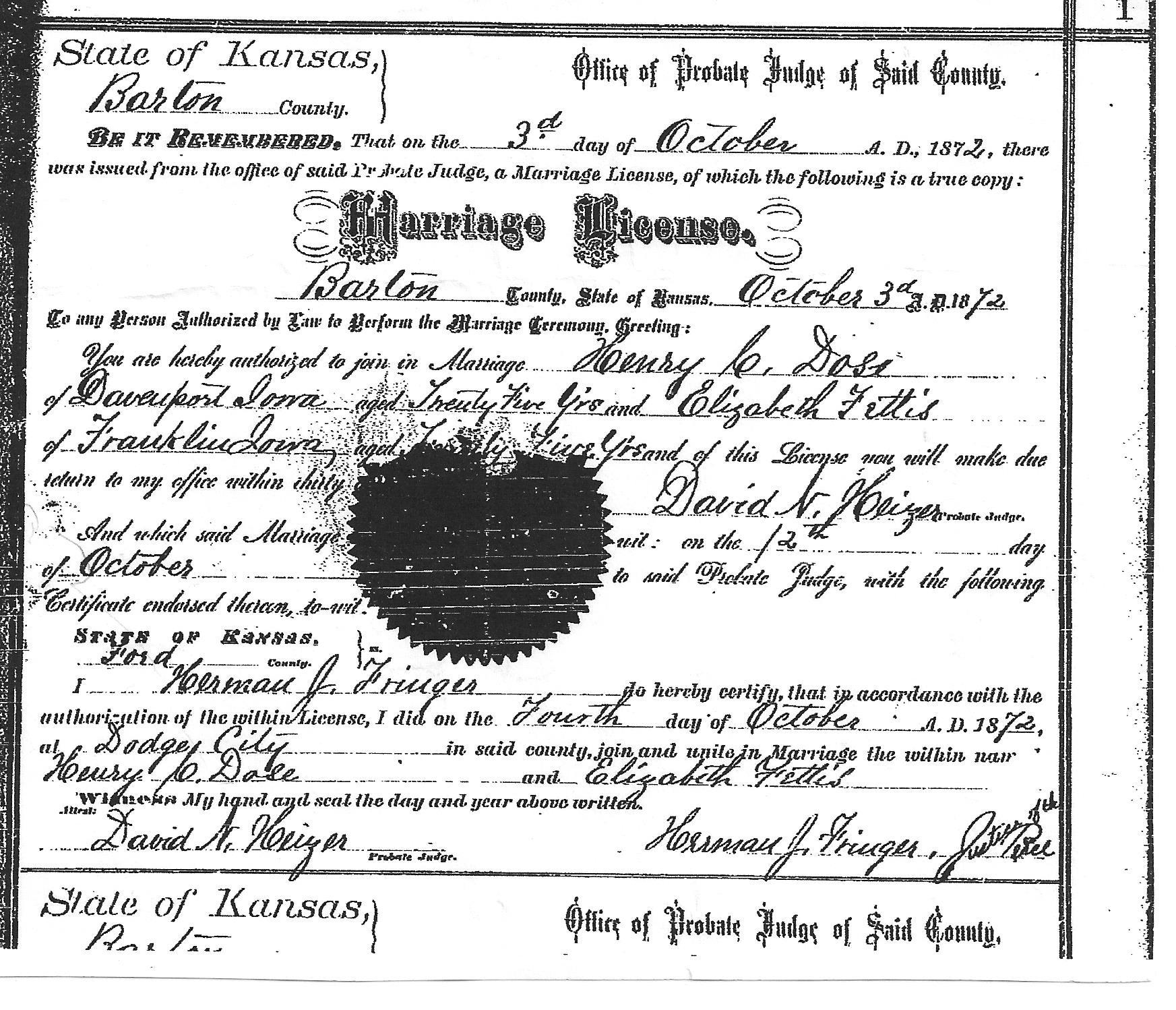
Marriage License of Henry C. Dose and Elizabeth Ferris [Hahn] - 3 October 1872, Barton County, Kansas.
-
Elizabeth Fettis is often described as a laundress although without a verifiable source to support the claim.12 As the wife of a serving soldier however it is most likely to have been the case and, if so, she would have exchanged the relative comfort afforded by a position in the commanding officer’s quarters for a more robust but financially lucrative life on “Suds Row.”
-
Company I, together with Company D, set out from Fort Lyon on 26 April 1872 for Camp Supply, Indian Territory (present-day Oklahoma) where they remained for the next two years. The Doses’ first child, Hattie Anna, was born at the post just under six months after their arrival, on October 22.13 It was from Camp Supply that Custer led the Seventh Cavalry south to the banks of the Washita River in November 1868 to destroy the village of the Cheyenne Indian chief Black Kettle.
-
In the late summer of 1874 both companies left Camp Supply for Alexandria, Louisiana to undertake Reconstruction duty and went into camp outside the town on 30 October. Dose was discharged as a private (artificer) on 4 January, 1875, having completed five years’ service.14 A second child, Charles, was born six days later.15
-
After a brief spell of civilian life Dose shows up at Shreveport, also in Louisiana, where, on February 1, 1875, he re-enlists in the Army and was assigned to Company G, 7th Cavalry, under the command of Lieutenant Donald McIntosh. On this occasion he gave his age as 25 years, which made him at least 12 months younger, probably more, than his first enlistment led us to believe. He was appointed trumpeter on June 17, the same year. His hitherto exemplary record of service was broken in the coming October when, according to the muster roll, he was “In confinement in Post Guard House.” The muster roll for December states he was to forfeit $10 of that month’s pay.16
-
Early in 1876 plans were being made to mount a three-pronged campaign against the ‘hostile’ Indians who had ignored the Government’s orders to report to appointed reservations. The Seventh Cavalry would form part of General Alfred H. Terry’s Dakota Column that was to assemble at Fort Abraham Lincoln, Dakota Territory. Company G left Shreveport on 19 April and arrived at Bismarck, via St. Louis and St. Paul, on the thirtieth. The same day, under the command of Second Lieutenant Edward S. Godrey, they crossed the Missouri River and went into camp two miles south of the fort.17
-
Much to the alarm of other parents, all three of Elizabeth Dose’s children arrived from Shreveport suffering from a highly contagious bout of scarlet fever. While Hattie and Charles were to make a full recovery, sadly, eight year-old Heinrich (aka Henry or Harry) succumbed to the disease and died on the evening of the sixth of May.18
-
For some unexplained reason, Cassius Carter, the senior trumpeter in Company G, was detained at Shreveport by the authority of the Department Commander [of New Orleans], given in a telegram, which directed that: “.. he must join company at his own expense if quartermaster cannot work with [rail] roads to reserve him a ticket out of transportation provided for his company.”19 Dose would likely have been delighted at his unexpected promotion, if only of a temporary nature which, alas, was to have fatal consequences.
-
General Terry’s Dakota Column finally moved out from Fort Abraham Lincoln early in the morning of Wednesday, 17 May 1876 with all the pomp and ceremony so eloquently described above. The rugged terrain and the unseasonable weather hampered its progress and after three long weeks the column had travelled only as far as the Powder River. Here a base camp was established and, on 8 June Dose took the opportunity to write the following emotive words to Elizabeth:
-
My Dear Wife
-
I received your Letter to day and was glad to hear from You and them little Children. I was a great deal troubled about it, that I didn get no letter from You, I am allwright if only I no that You and them Children ar all well, Wear about 250 miles from Lincoln on the Powder River but we dintn see a sign of an Indian but we ar expecting every day to meet with them, we had terrible bad wether and a Terrible Snow Storm the first and second June
-
The Command is stopping her on Powder River and resting two days, wear going to leave here in the Morning 5 o,clock for the Yellow Stone, The Ration ar running out very near, and so we have to hurry to get to the Yellow Stone Myself and Hageman and Weis got some Antilops Meat from them Indian Scouts, but had to pay $2.00 for a Quarter of it, I spend at already $8.00 for Eating, Gen. Tarry [Terry] said if we get Sitting bull and his trib soon, then we ar going home, but if we dont, we will stay 3 months and hunt for him. I wish for mine part we would meet him to morrow Serg Botzer and me came to the conclusion, it is better anyhow to be home and baking Flapjacks, who [?] we get home we will pay up for this and bake Flapjacks all the time,
-
Dear Lizze I can not forget Harry, I dont no how it is but his in my Mine all the time, and sometime I worry a great deal about him, The best ting for you to do is to go to the Carpenter and get him to make a paling fenz rows [for] The Grave and dont forget to send for that Tombstone, for we dont no if we got anny time to spare after we get back again,
-
Take good care of Yourself and Hetty and Charly and dont forget Your Husband and wrigth to me when ever You get a change, for I am lonely her to hear from You,
-
Serg Botzer, Hagemann, Weis, Serg Northeg, Others and very near the hole Camp send ther best Regards to You and Hetty and Charly
-
I for myself send my love and a Kiss to You and one to Hetty and Charly
-
My best Regards to Mrs Hughes and her Children and to Klein and Mrs Klein and Mrs James and to Serg Loyd, Lawler and Luther.
-
I remain Your true and loving Husband
-
Henry C Dose
-
Trumpeter Troop G 7 Cavalry20
-
The same day that Dose wrote to his wife, Cassius Carter was ordered to rejoin his company and would have arrived at Fort Lincoln shortly thereafter. In a letter to Custer, Libbie reported: “Carter has returned and is chief trumpeter. He really sounds the calls beautifully. But his long-drawn notes make me heartsick. I do not wish to be reminded of the Cavalry.”21 One can only imagine the thoughts that passed through the mind of Elizabeth Dose, who was no doubt still coming to terms with the loss of young Harry.
-
On the morning of the 25 June, Dose along with John Martin, Company H, and possibly a third trooper, was detailed to be Custer’s orderly for the day even though his company was assigned to Reno’s battalion. This left Company G without a recognised trumpeter which may have been a contributory factor to the chaos that occurred during the withdrawal from the timber.
-
Henry Dose was killed on the first day of the battle and his body is alleged to have been found on the flat ground near the Little Bighorn River, between Medicine Tail Coulee and Deep Coulee. At the Reno Court of Inquiry Lieutenant Charles C. De Rudio said: “Probably 500 yards from the ford we found a dead body, that was the first dead body we found, lying in the bottom of a little coulee. He was so much disfigured that I did not know who he was, only the marks on his pants showed he was a trumpeter.” 22 Dose perhaps? Private Henry Petring, also in Company G, who was wounded in the eye and hip in the hilltop fight, told Walter Camp that Dose was discovered “half way between Custer and Reno with arrows in his back and sides.”23 Was he was carrying a message from Custer?
-
Horned Toad and Speckled Cock, two Crow Scouts with Colonel John Gibbon’s forces at the Little Bighorn on 27 June rode into Fort Lincoln a few days later bringing news of Custer’s defeat but their story was either dismissed or suppressed by the Army authorities. However this did not prevent rumors of a terrible disaster soon becoming until the worst fears were formally confirmed around 7:00 am on 6 July when acting post commander Captain William S. McCaskey, 20th Infantry, accompanied by Lieutenant Charles L. Gurney, Sixth Infantry, and Dr Johnson Van D. Middleton, the post surgeon, began the painful task of breaking the news to the 25 or so widows, one of whom was Elizabeth Hahn Dose.
-
The following summer Trumpeter Henry Dose’s remains were re-interred in the mass grave on top of Last Stand Hill and his name inscribed on the south-facing panel – fifth from the top of the right-hand column – of the Cavalry Monument, which it was erected in 1881.
-
Having suffered two bereavements in as many months and with two young children to support, it is not altogether surprising that a grief-stricken Elizabeth Dose should find solace in the arms of a trooper from her late husband’s company, though Edward Garlick the lanky, English-born first sergeant who was on furlough at the time of the battle, may well not have been the first name to come to mind. They were married on November 21, 1876 but that’s another tale waiting to be told.
-
An amazing postscript to this fascinating story was published in Iowa eleven years after the battle. It reads:
-
Elizabeth was a daughter of the first wife of Charles Hahn, and is the wife of Edward Garlick, Sergeant of Troop G, 7th United States Cavalry, now stationed at Ft. Meade, Dak. Her first husband was Henry Dose, a soldier who shared the fate of many other brave men when Gen. Custer and his gallant band were masacred [massacred] by the savages. Mrs. Garlick has been on the frontier for years, sharing all vicissitudes of her husband’s soldier life, and is the owner of the only horse uncaptured by the Indians when the Custer massacre took place. It was ridden three days and nights without food, and was presented by its owner and the guide of Custer, to Mrs. Garlick.24
-
While it is a historical fact that all three of Custer’s guides were killed in the battle and Comanche is symbolically acknowledged as the sole equine survivor of the ‘Last Stand,’ there is the remote possibility that this ostensibly apocryphal anecdote might contain an element of truth if the words “a scout with Gibbon” were substituted for “the guide of Custer.” Why a Crow Scout who had ridden over 300 epic miles in three or four days would choose to give his mount to a Seventh Cavalry laundress is, of course, an entirely different matter!
- Notes and Sources to be added.
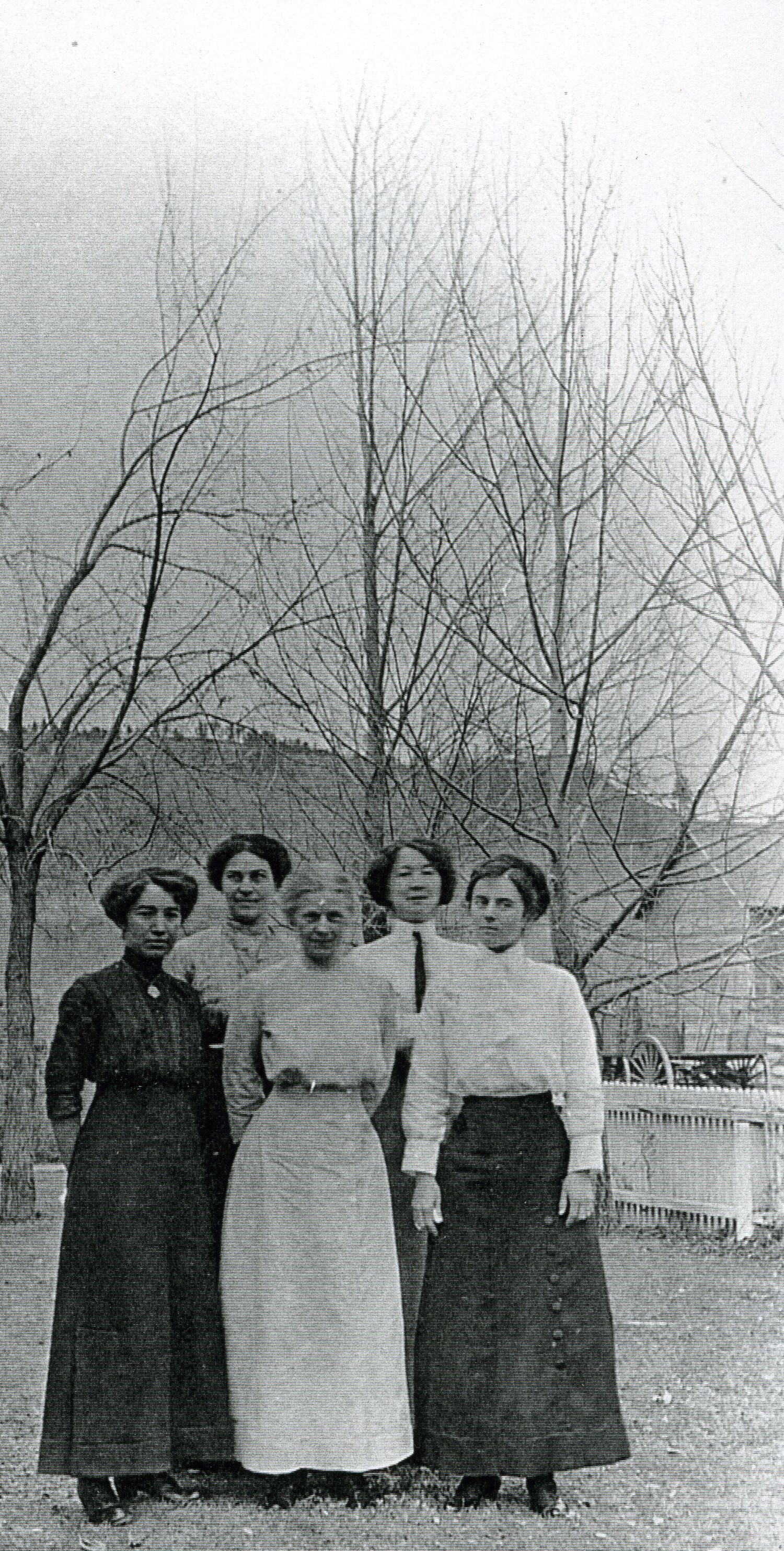
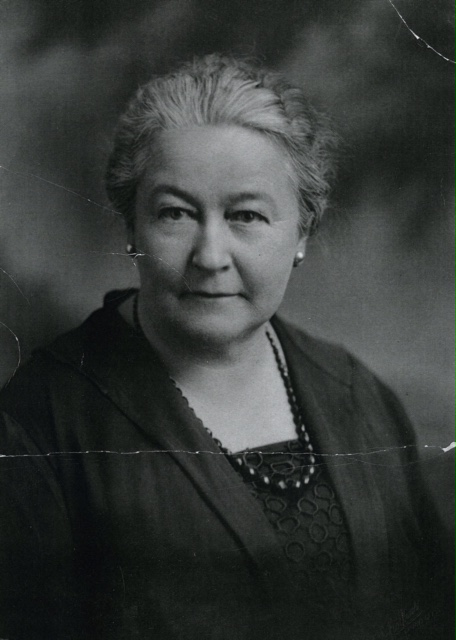
Hattie Dose Garlick Ackerman in later life (above) and Anna Elizabeth Hahn Dose Garlick, also in later life, in the centre of the group photograph (left).
16. Private Martin McCue, Company K
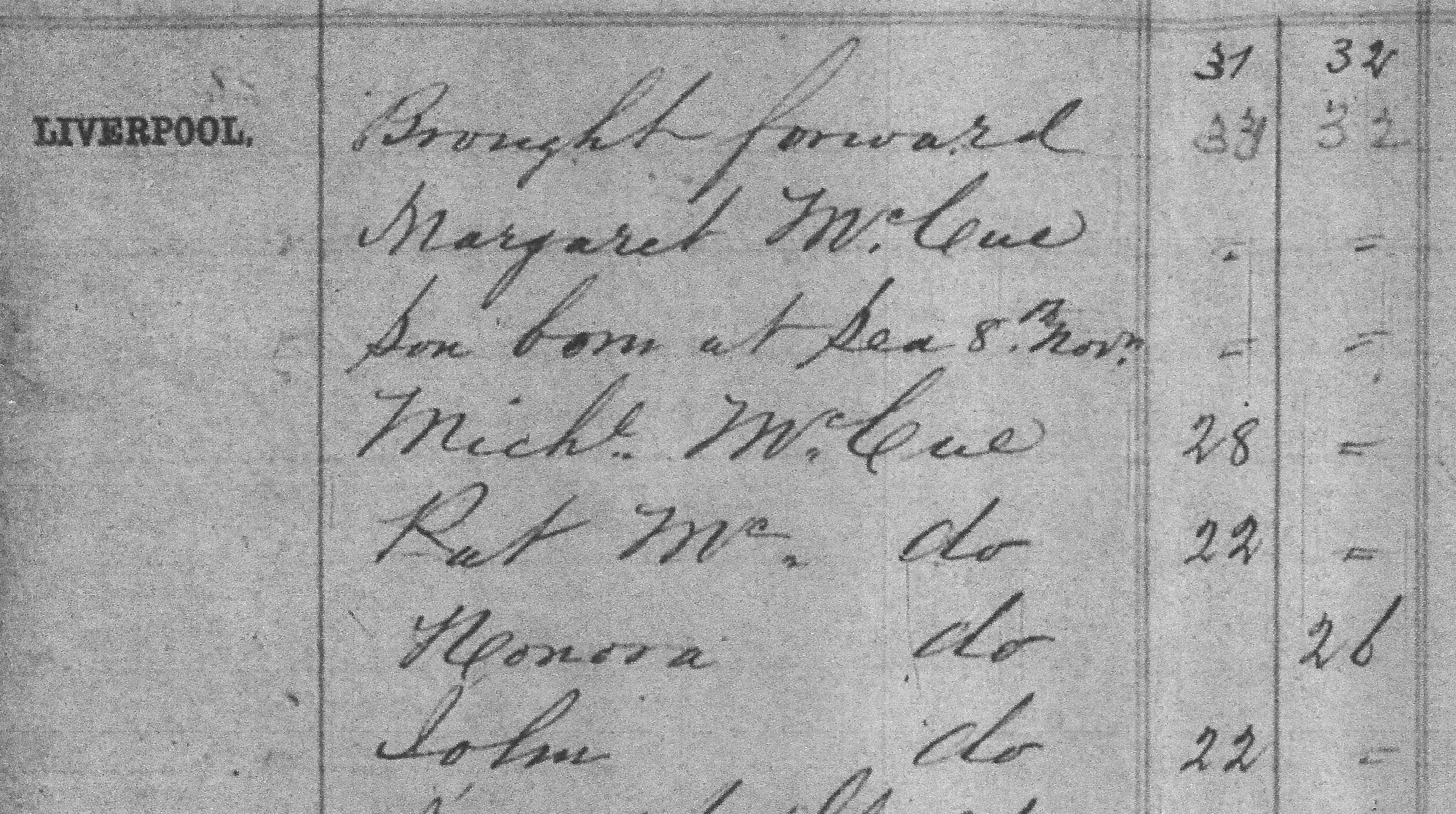
- An extract taken from the manifest of the sailing ship Panola outbound from Liverpool to New York, showing a son (later named Martin, almost certainly after a near relative also on board) of Patrick and Mary McCue, born 8 November 1851. His parents, both from Ireland, are listed as being age 32 and 28 years respectively.
- Although Sergeant Major William H. Sharrow gave his place of birth on both post-Civil War enlistments as “at sea” one trooper, namely Martin McCue, was actually born on board an emigrant ship from England to the United States.
- McCue was enlisted into the United States Army on 28 October 1872 at Philadelphia, Pennsylvania by Captain Samuel Whitside, transferred to the 7th Cavalry on 22 November and joined Company K at Yorkville, South Carolina, on 9 December. Described as having grey eyes, brown hair, a ruddy complexion and standing 5′ 6 1/2″ tall, previously employed as a ‘card stripper in a woolen mill’ [Military Register, p. 199. Williams], he was with his company on the Yellowstone Campaign (1873), the Black Hills Expedition (1874), the Battle of the Little Bighorn – hilltop fight (1876) and the Nez Perce Campaign (1877).
- He served no less than four other enlistments in the United States Army – 1st Cavalry (two), 2nd Cavalry and 10th Infantry. Was discharged 7 July 1893 at Fort Marcy, New Mexico Territory, on a surgeon’s certificate following “the loss of one eye from an incised wound by broken glass during a row in a cafe at Santa Fe, New Mexico, not in the line of duty.” [Military Register, p. 200]
- McCue was admitted to the Soldiers’ Home, Washington, D.C., on 19 August 1893 where he lived until his death (cause – cerebral haemorrhage, broncho-pneumonia and arteriosclerosis) age 72, 6 December 1923. Buried on 10 December in the Soldiers’ Home National Cemetery, Section 1, Grave 8631. [Men With Custer, 2010, p. 255. Nichols]. He never married.
- Note: Both Nichols and Williams give “10 November 1851 at sea” as McCue’s date and place of birth, while Nichols adds the words “from Ireland.” That apart each volume contains an excellent account of his army career, which extended over 20 years.
17. Private William George, Company H

The flyer for an Montana Military Living History event, 15 June 2026.
- Honoring Private William George, Company H, with a new headstone
- Men With Custer (2010), edited by Ronald H. Nichols and Participants in the Battle of the Little Big Horn (2016), by the late Frederic C. Wagner III, are useful books of secondary reference rather than archives of actual information. My initial research into the heritage of Private William [Montelle] George, Company H, finds him being a son of an English father, William George, and his mother, Ellen, the daughter of Scottish immigrants (which may account for his sandy hair!). A strong connection with the UK, indeed. He was baptised at the Second Presbyterian Church in Lexington, Kentucky on 16 July 1848, though most likely born the year before (this is supported by the 1860 census of Cincinnati). If correct, it verifies the age of 28 he gave on his second enlistment on 1 May 1875, which means he was 29, not 26, which is inscribed on his headstone, above.